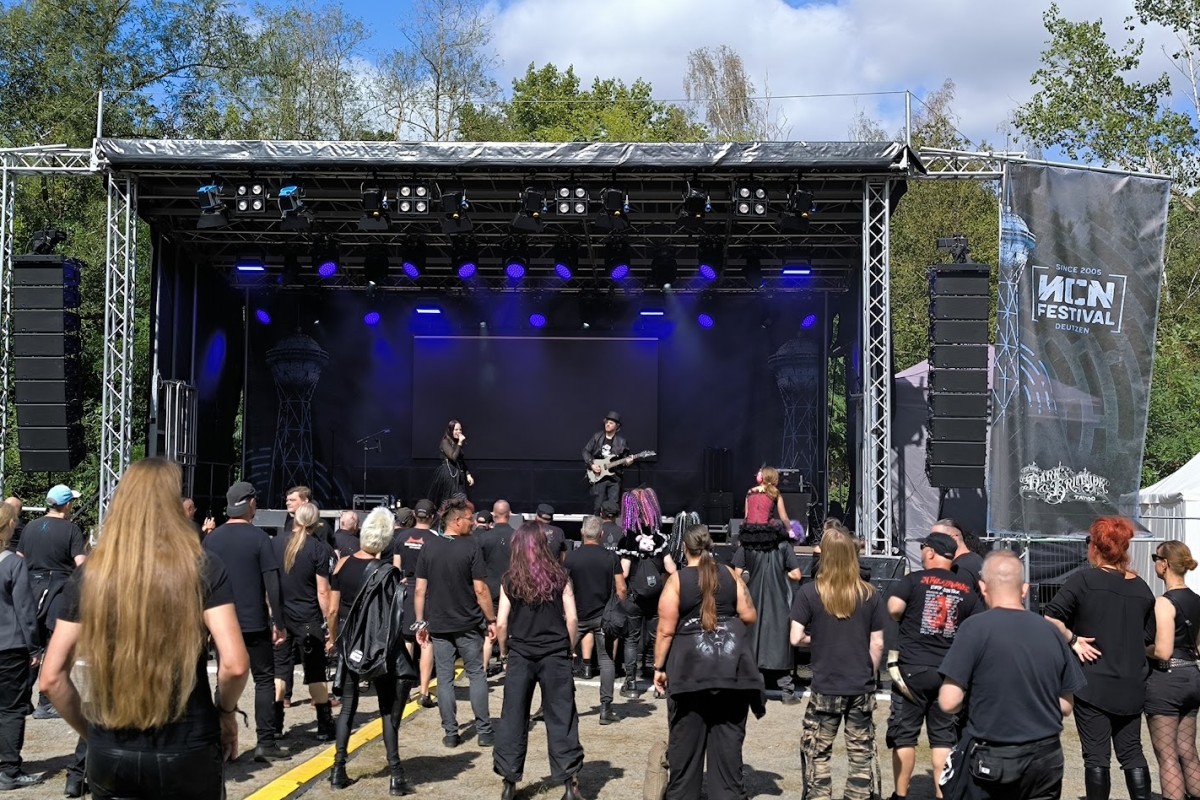
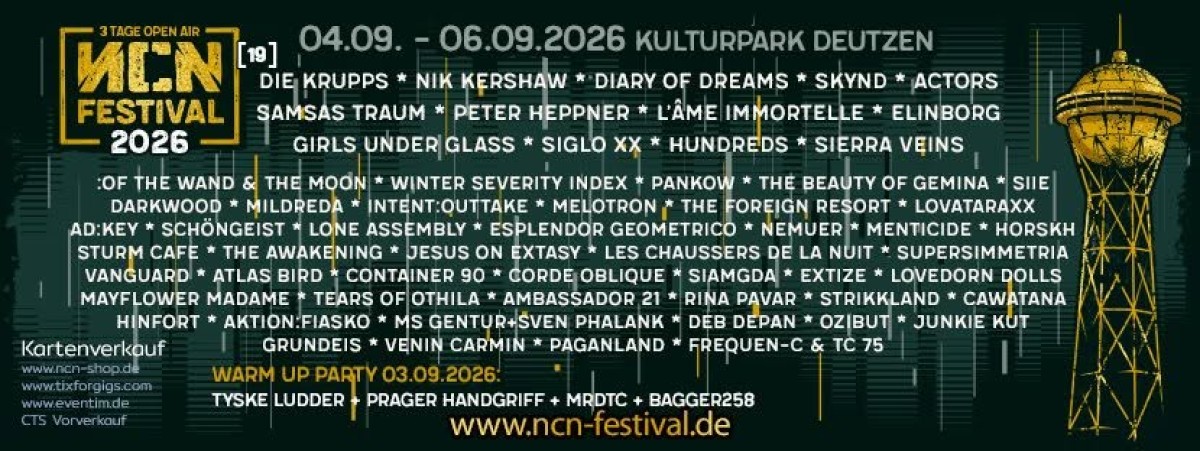
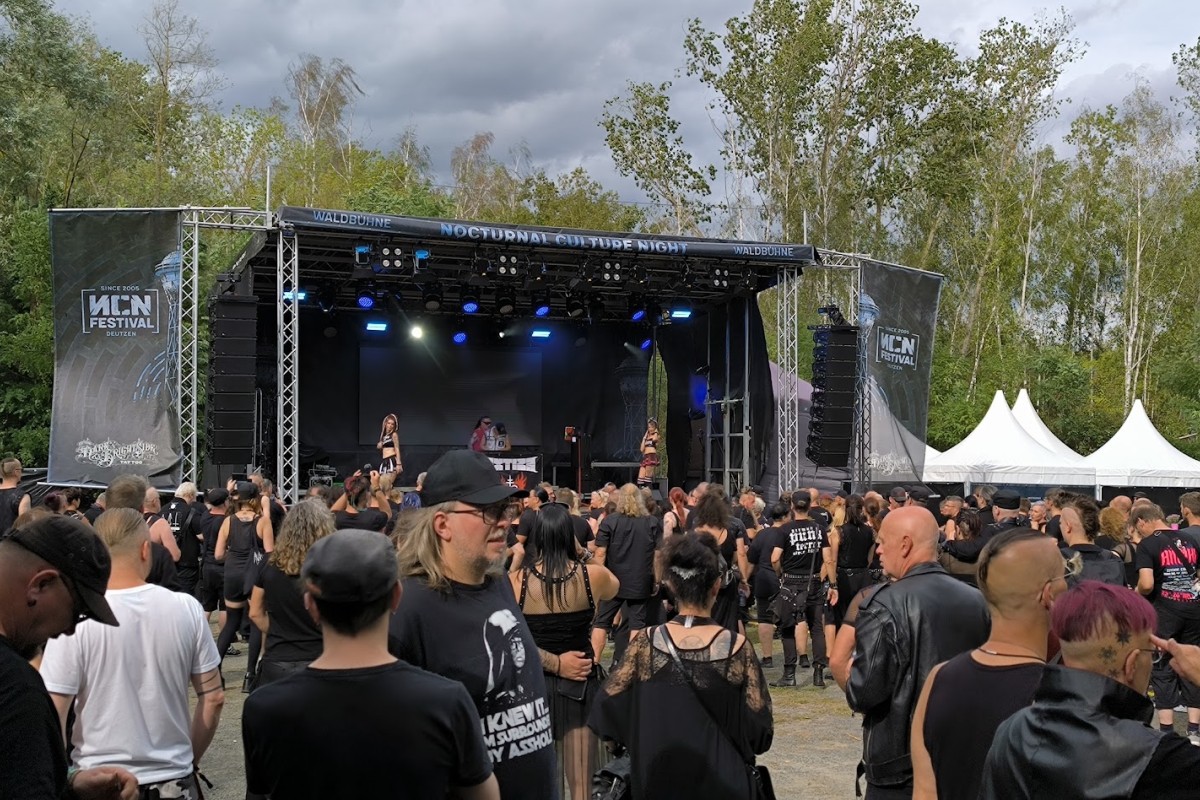
Nocturnal Culture Night (NCN) is one of Germany’s most cherished boutique dark-scene festivals, held annually in the Kulturpark Deutzen, a woodland park near Leipzig. The 2026 edition took place from 4–6 September, with a warm-up party on 3 September. The festival is renowned for its intimate, nature-focused environment: shaded forest paths, open-air stages, and a relaxed atmosphere. Unlike large commercial festivals, NCN offers a cosy capacity of around 2,500 visitors and a park layout that encourages slow wandering between stages under the trees. A nearby lake provides a refreshing break in late-summer weather, and the Freisitz area offers space to unwind.
NCN is known for its curated blend of electro, synthpop, darkwave, post-punk, neofolk, gothic rock, industrial and EBM. Somewhere between 60 and 70 artists perform across five open-air stages (Amphi-Bühne, Park-Bühne, Kultur-Bühne, Wald-Bühne, and Lese-Bühne).
Much like Frantic Fest, NCN happened completely unplanned, simply because at some point we felt like it, although I don't think two festivals in such a short space of time are the best idea. I found it quite exhausting. We had already decided while planning the trip to skip Thursday's warm-up party because we simply do not need warming up. The plan was to set off sometime late on Thursday evening, but by the time Tomaz finally started the car, the clock was showing exactly midnight. In an effort to avoid Slovenian motorways, which with their seemingly endless traffic jams rather contradict the very purpose of a motorway, we opted for the slightly longer route through Tarvisio in Italy. Ideally, we would have avoided Austrian motorways as well. The vignette system does not seem particularly sensible when it still leaves you queuing at tunnel toll booths, especially considering how expensive those tunnels happen to be. However, in this case, avoiding Austria altogether would have added considerably more than just a few extra kilometres to the journey. Fortunately, the greater part of the route lies on German autobahns, which, in our opinion, remain an example others should follow.
Friday, 4 September 2026
With a few stops along the way, we arrived at Kulturpark Deutzen at around 13:00. First came accreditation, followed by a choice between two camping options: pitching a tent at the campsite near the festival grounds while leaving the car outside, or camping a few hundred metres away on the car park itself. Neither option particularly appealed to us, but we eventually chose the latter.
After setting up our tent, we headed straight for the Wald-bühne. Naturally, our first order of business was a cold beer before settling in for the day's first performance. Taking to the stage between 15:30 and 16:00 were German electro, dark techno and EBM innovators Extize. Simultaneously, French industrial metal/EBM outfit Horskh were performing on the Park-bühne.
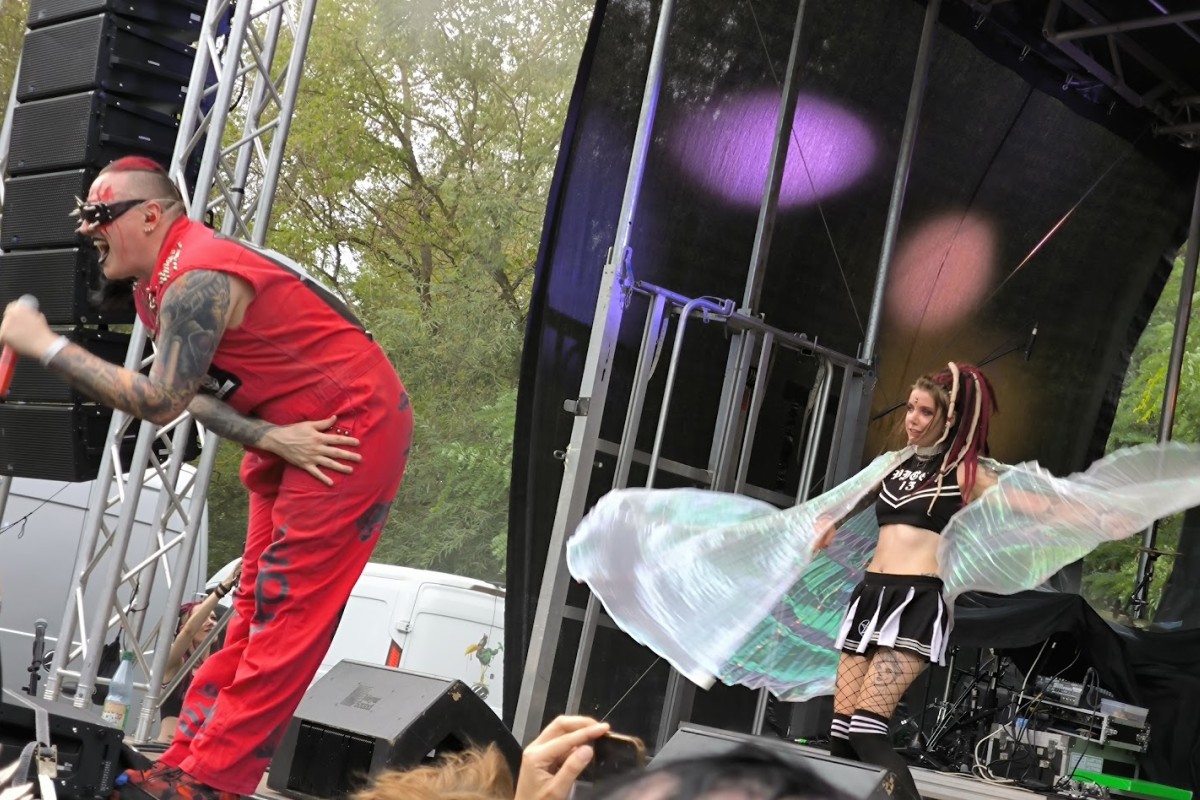
Tomaz had the following to say about Extize's performance: "I was particularly curious to see how Raphael and company, the formation renowned for constantly pushing the boundaries of the genre, would translate their explosive club energy to a festival setting, especially after witnessing their outstanding performance in Ljubljana just over a year ago. The set opened with 'Dirty Freddy', taken from their 2022 album MonStars. This time, however, Extize appeared in their full live incarnation, complete with three dancers providing synchronised choreography and, perhaps more importantly, a fully vocal performance rather than the largely instrumental presentation we experienced in Ljubljana. While the enhanced visual production undoubtedly made the show more engaging to watch, it somehow failed to leave quite the impact I had anticipated. Something seemed to be missing. The setlist felt somewhat fragmented, drawing material from across the band's catalogue without creating a particularly coherent narrative or flow.
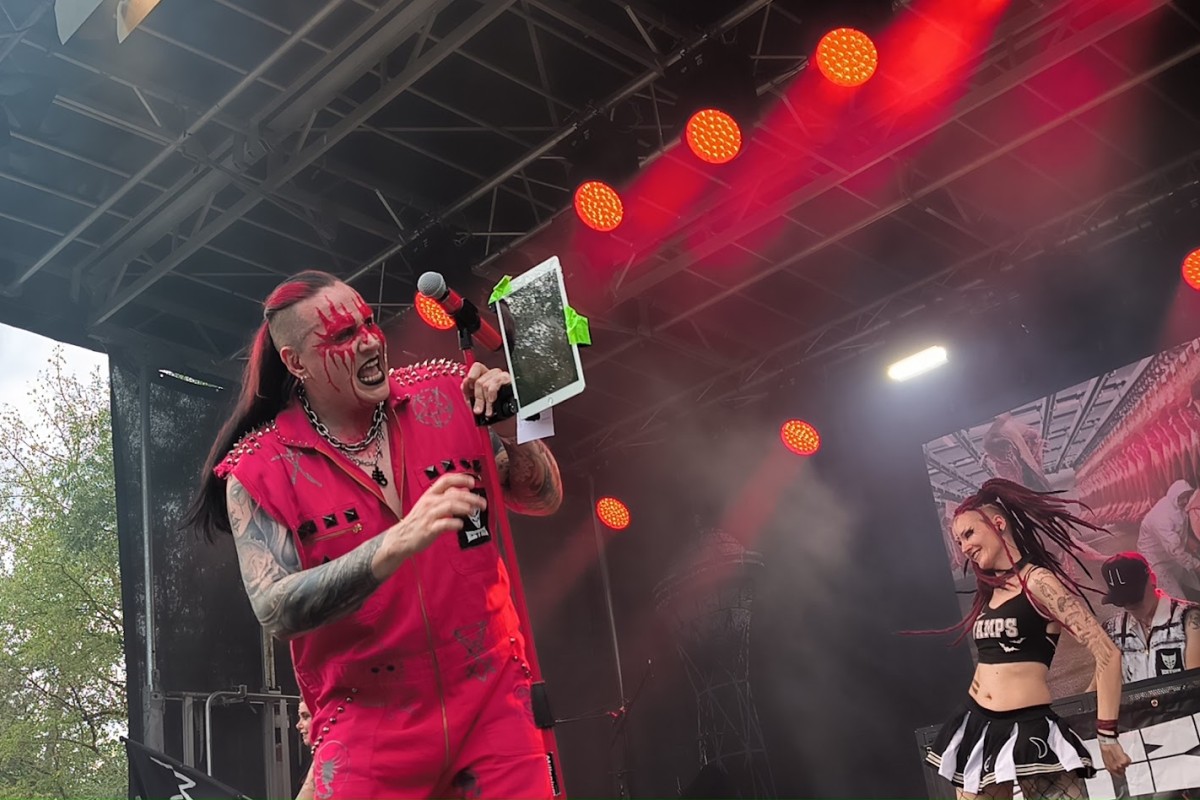
At least, that was my impression. Perhaps this was simply a consequence of the band's limited thirty-minute slot and an attempt to make the most of every available minute. That said, there were certainly highlights. The performances of 'MediEVIL' and 'Gothy Cool', tracks that can now comfortably be described as Extize classics and which increasingly find their way onto club and radio playlists alike, were particularly well received and injected the set with exactly the kind of energy many had come to expect. Ultimately, Extize left me, and I suspect a reasonably sized audience as well, with mixed feelings. Visually, the performance was dynamic, energetic and highly entertaining, showcasing the band's flair for spectacle. Musically, however, it felt less convincing than expected, resulting in a set that impressed the eyes more than it did the ears".
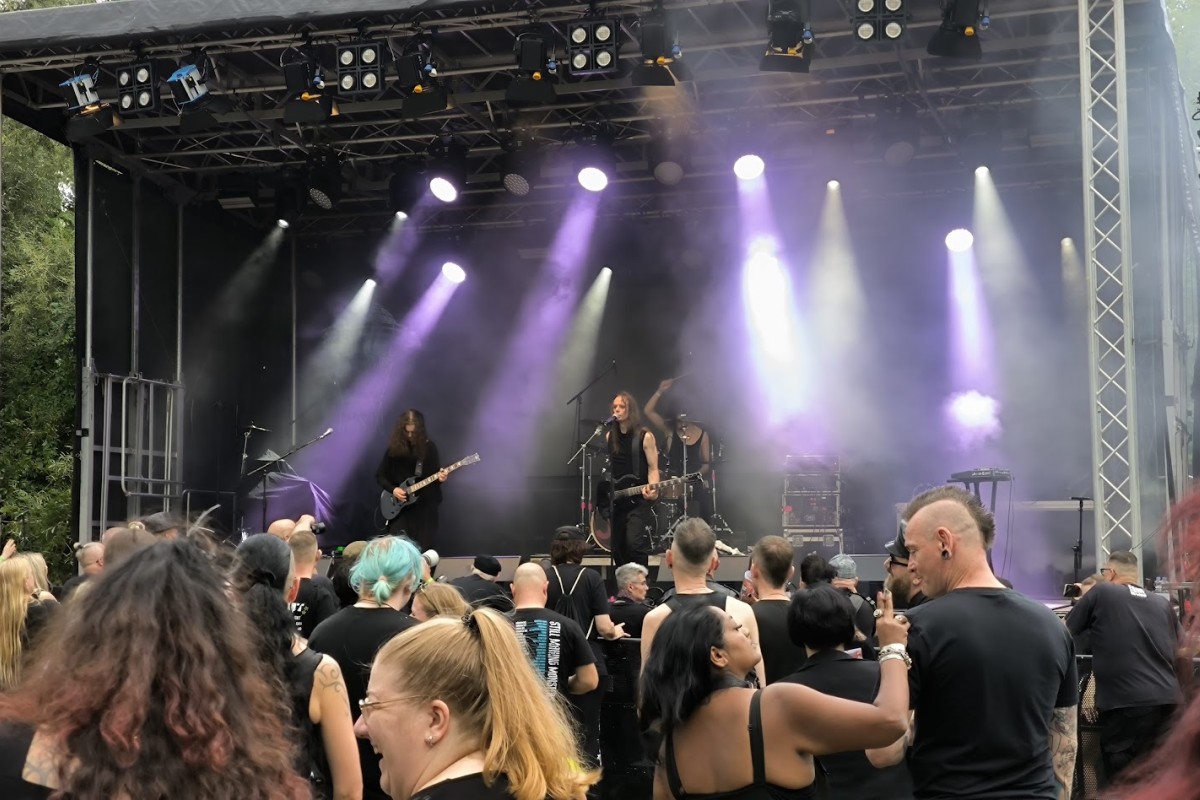
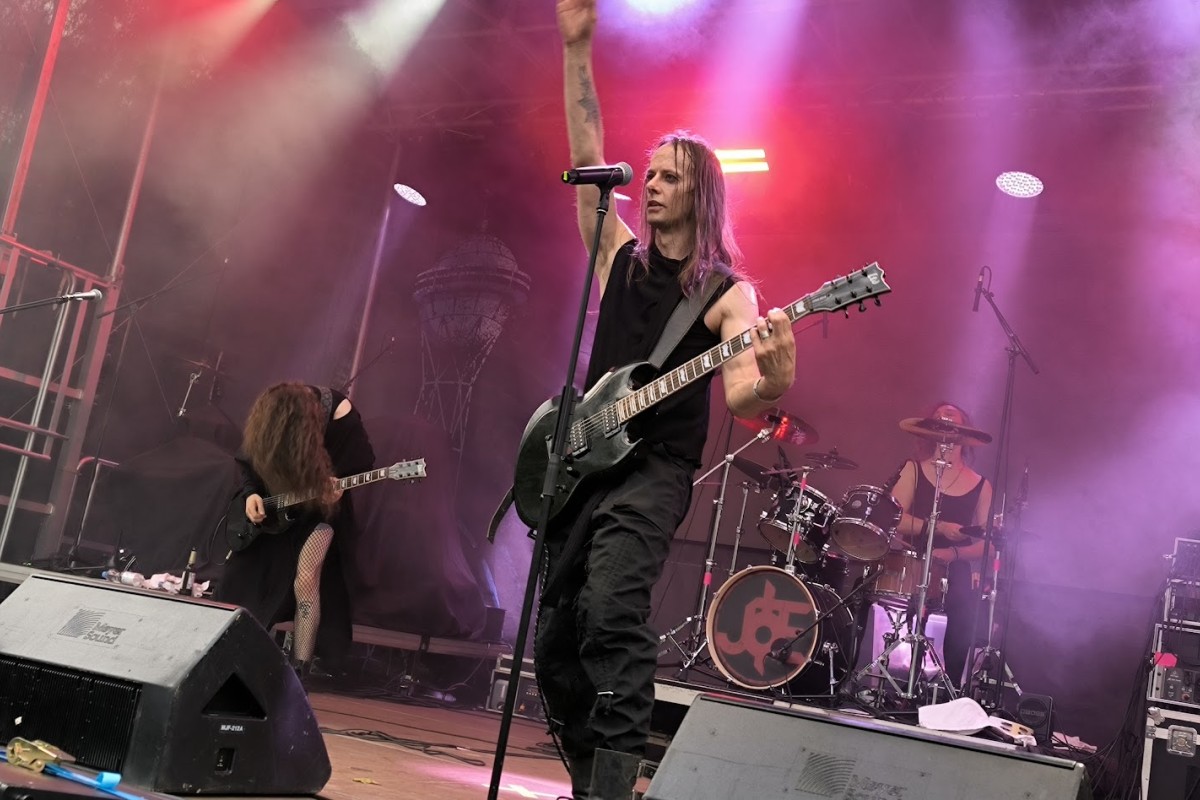
I do hope Raphael's Christian Oma appreciated the band-and-audience selfie taken especially for her. After the performance, Tomaz and I exchanged a few words with Raphael before German industrial/gothic metal outfit Jesus On Extasy took over the same stage at 17:00. Once again, Tomaz shares his impressions: "Their forty-minute set drew heavily from their latest studio album, Between Despair And Disbelief, offering festivalgoers a concise introduction to the band's current creative direction. This was my first opportunity to see the band perform live, and the overall impression was one of solid professionalism. While the performance itself was undeniably competent, I could not shake the feeling that the band's delivery remained somewhat linear throughout the set. Despite the quality of the musicianship, there was a certain lack of momentum and impact that might have prevented the festival audience from becoming more fully engaged with the performance. Perhaps unsurprisingly, the crowd in front of the stage was noticeably smaller than it had been for Extize, and the response from those present remained rather restrained. That said, the band's commitment to their craft was evident from start to finish.
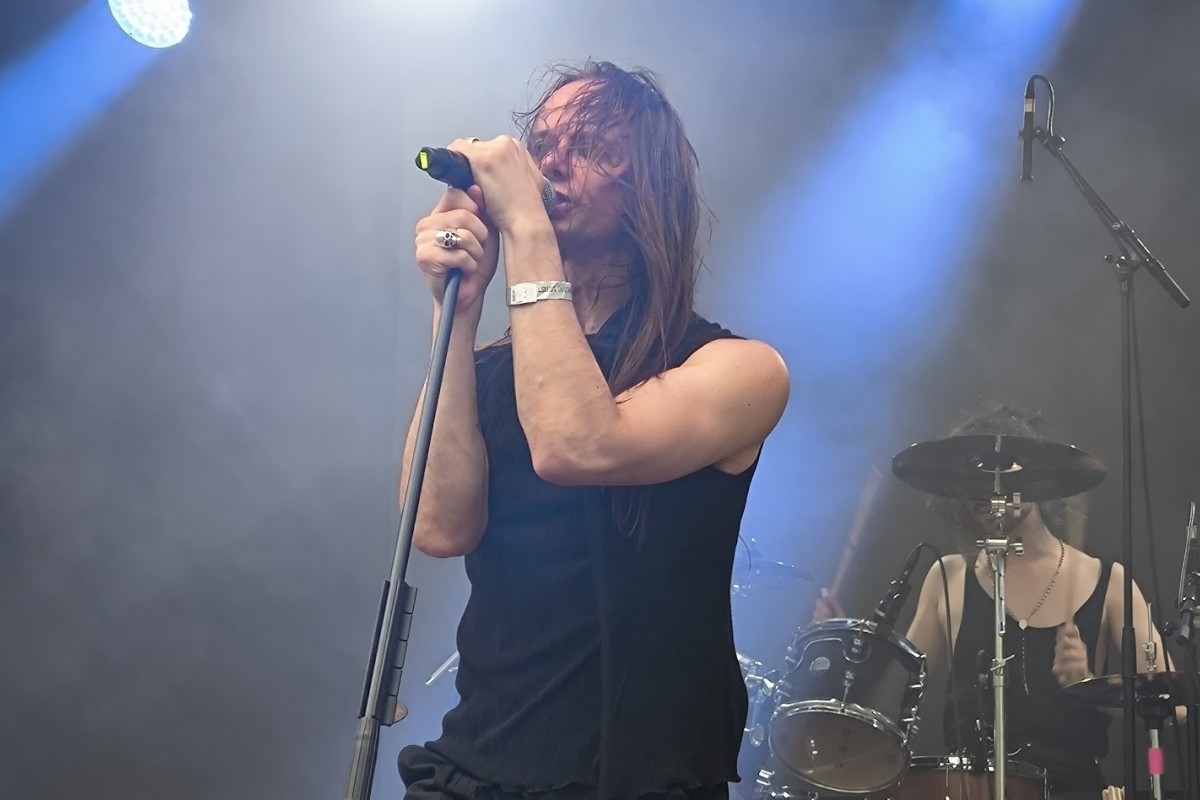
Their stage presence felt more akin to that of a traditional gothic rock or gothic metal band than a modern industrial act, which gave the performance a distinctive character of its own. Special praise must go to frontman Dorian Deveraux, whose emotionally charged delivery, expressive body language and commanding presence provided much of the show's focal point. His performance added an important human dimension that elevated the material beyond a straightforward live rendition. Ultimately, Jesus On Extasy delivered a polished and professionally executed set, supported by a strong live sound and confident musicianship. Yet, despite all the right ingredients being present, there remained the sense that something elusive was missing, that extra spark capable of fully immersing the audience and drawing them into the atmosphere the band sought to create. As a result, the performance was enjoyable and well executed, though it stopped short of being truly captivating".
Next on our schedule was a performance by Faroese singer-songwriter Elinborg Pálsdóttir, known mononymously as Elinborg. Until then, however, we had almost two and a half hours to spare, so we headed back to our tent to grab something to eat and, more importantly, put on some warmer clothes. While the afternoon had been almost summery, the temperature dropped noticeably as evening approached. There was no sign of rain, and the possibility barely crossed our minds. In fact, we had not even bothered to check the weather forecast. If only we had.
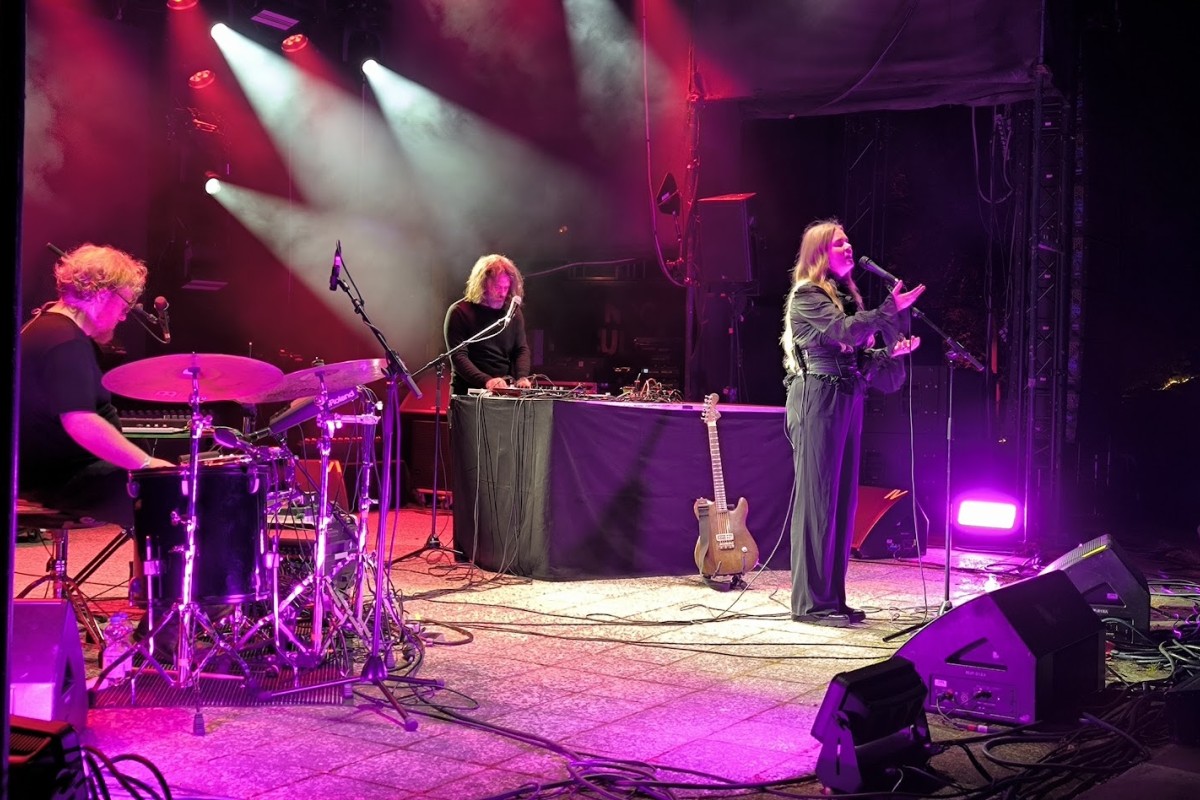
We arrived at the Amphi-Bühne, the festival's largest stage and my personal favourite, almost half an hour before Elinborg's set was due to begin, keen to secure ourselves a seat. By then, darkness had already descended on the venue, and the area in front of the stage, still relatively empty when we arrived, was beginning to fill up quickly. Elinborg and her two accompanying musicians, one on keyboards and the other on drums, were already on stage carrying out their soundcheck, and I must admit that even this immediately drew me in. After all, it was my very first encounter with Elinborg's music.
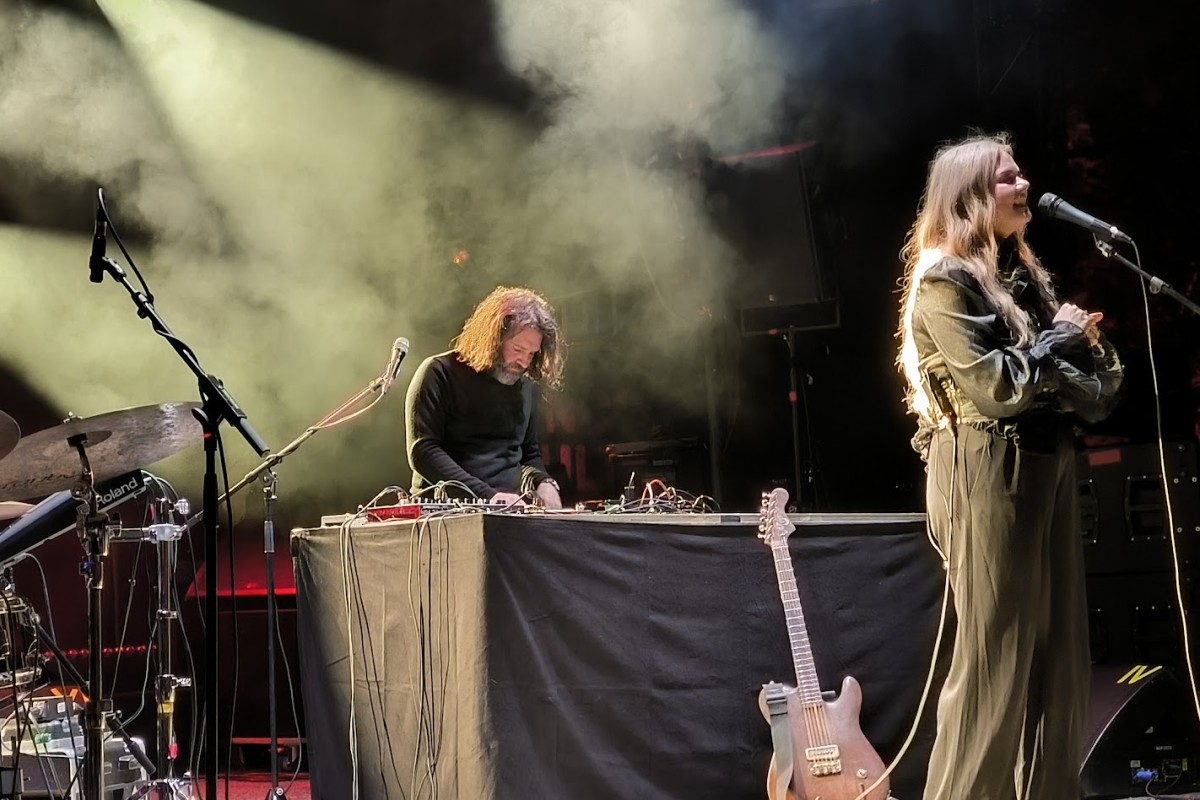
The performance left a particularly strong impression on Tomaz: "I must say that I was looking forward to one performance in particular: that of Elinborg, whom many readers might know as the younger sister of the renowned Eivør. However, such comparisons quickly fade into the background the moment her music takes centre stage. Ever since I first encountered her unique blend of Nordic dark folk, vibrant electronica, pop, post-rock, shoegaze and other subtle influences, I have found her artistic vision both captivating and deeply distinctive. As the band began their set, it became apparent from the very first notes that the audience was witnessing something special. Whether holding a guitar or standing alone at the microphone, Elinborg completely mesmerised those gathered in front of the stage. The performance was built upon a spellbinding atmosphere, breathtaking soulful vocals and a presentation that remained understated yet exquisitely refined throughout. Every detail felt carefully considered, allowing the emotional weight of the songs to shine through without unnecessary embellishment.
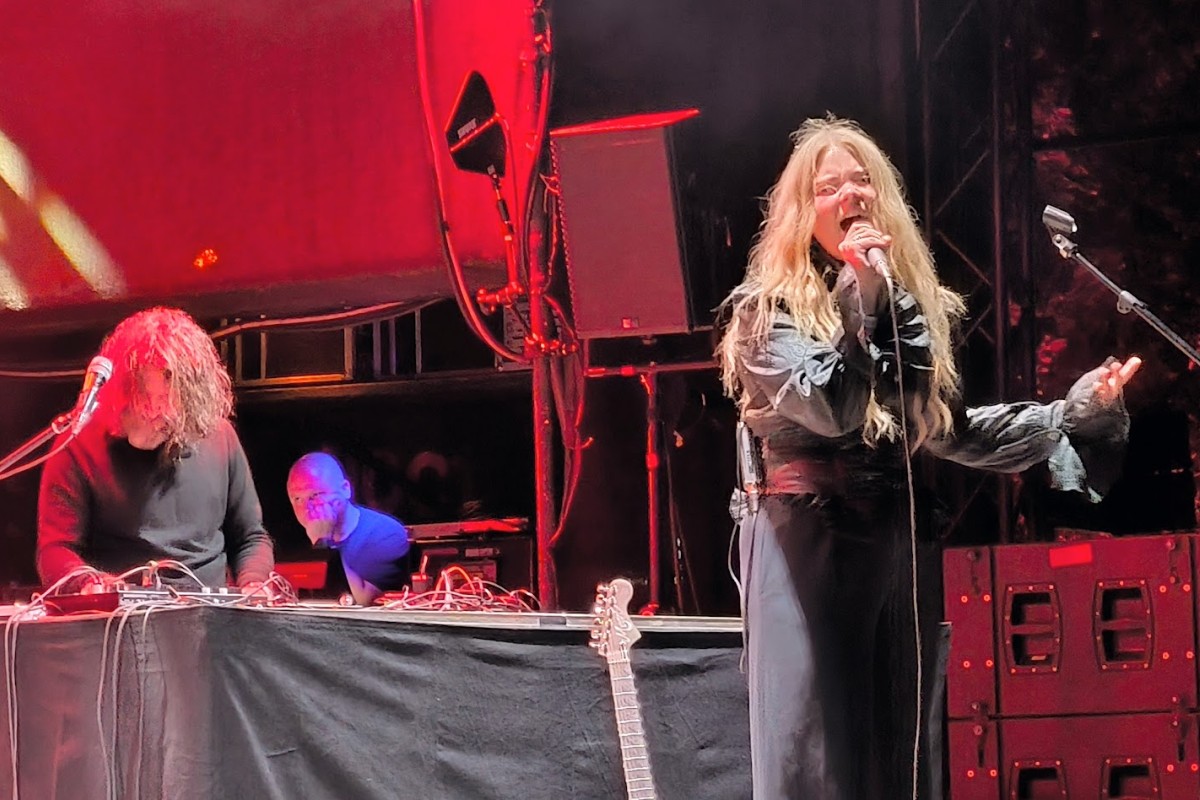
Over the course of the set, Elinborg performed nine songs, drawing primarily from her excellent 2025 album Í Ævir, while also revisiting several tracks from Vera (2022). Each song was met with enthusiastic and prolonged applause, a clear indication that the audience had wholeheartedly surrendered to the dreamlike soundscapes unfolding before them. The emotional connection was evident not only among those watching but on stage as well. Elinborg Pálsdóttir herself appeared visibly moved by the warm reception she received throughout the performance. By the time the final notes faded away, many in the crowd, myself included, were hoping for one more song. However, as is so often the case with festival appearances, no encore was forthcoming. Even so, the set left a lasting impression. In a festival programme filled with memorable performances, Elinborg delivered one of the weekend's most enchanting and emotionally resonant moments, demonstrating that sometimes the most powerful performances are those that rely not on spectacle, but on atmosphere, sincerity and the rare ability to transport an audience somewhere else entirely".
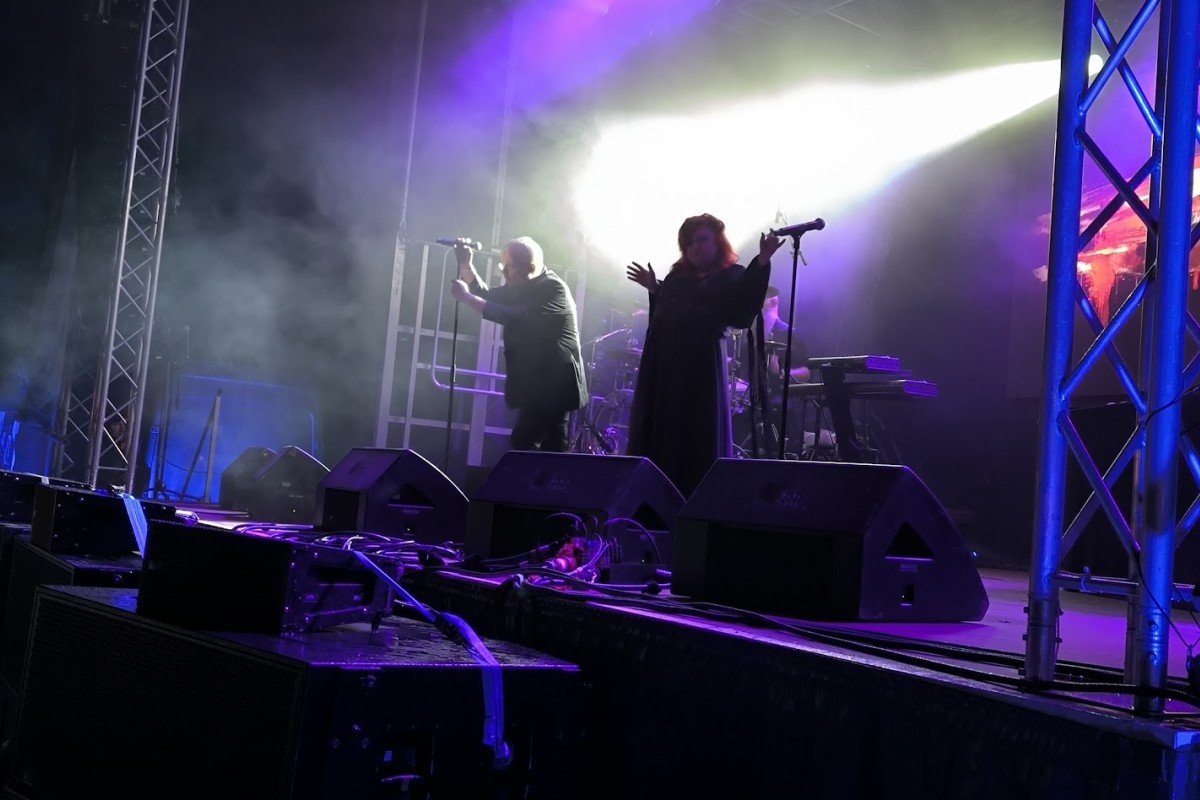
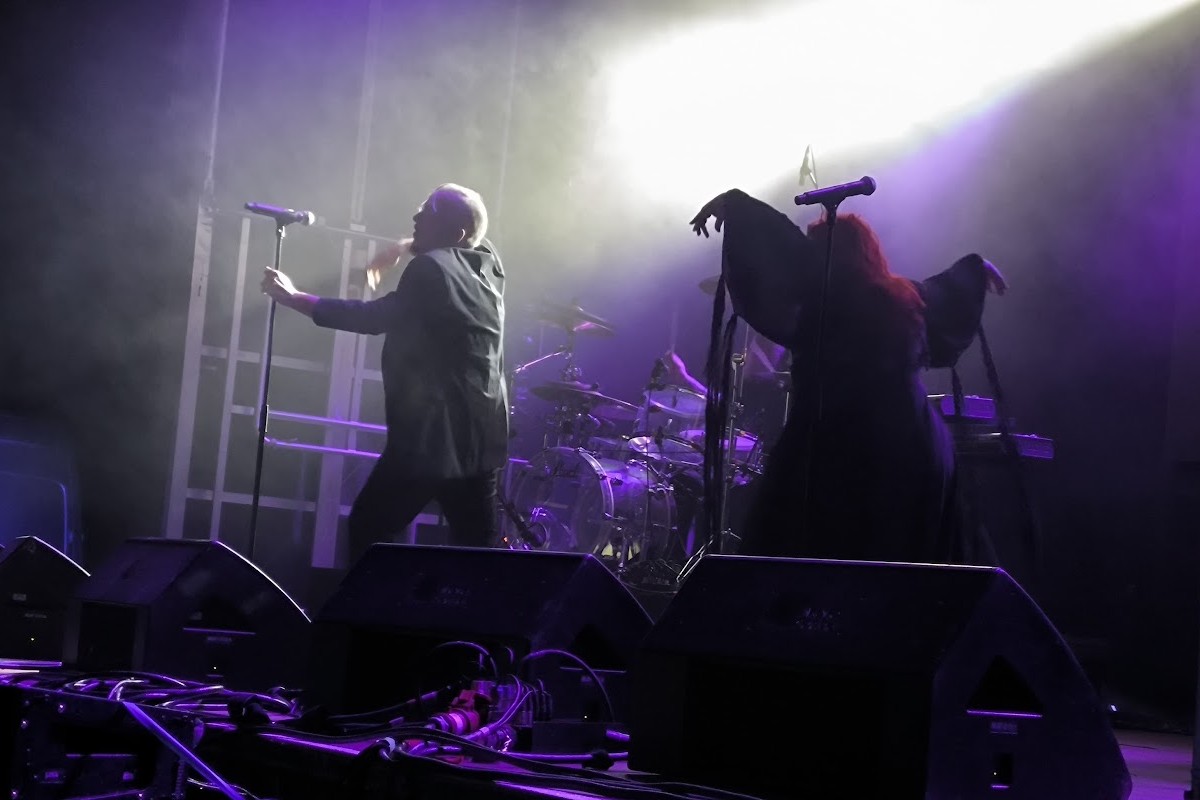
We had to make our way quickly to the Wald-Bühne, as Austrian darkwave, electro and gothic music pioneers L'Âme Immortelle were due to take the stage there in just ten minutes. And once again, I shall leave the narrative to Tomaz: "Few bands within the dark scene require less introduction than the duo of Thomas Rainer and Sonja Kraushofer. Since their formation in 1996, they have played a significant role in shaping the sound and aesthetic of dark music as we know it today. This was the second time Jerneja and I had the opportunity to see them live, the first being at M'era Luna Festival in 2023, where they left a lasting impression on me. Expectations were therefore understandably high. The set opened with the powerful 'Stumme Schreie', which, interestingly, sounded noticeably less metallic than its studio version on Gezeiten. As the song began, only Thomas and the accompanying live musicians were visible on stage, while Sonja was nowhere to be seen, despite her vocals clearly being heard. For a moment, I assumed these were pre-recorded parts and that we would be witnessing a performance centred solely around Thomas. As it soon turned out, Sonja was there all along, beginning the show amongst the audience before making her way onto the stage by the end of the song. From that moment onwards, the real spectacle began. What followed was a succession of beloved classics, including 'Gefallen', 'Fallen Angel', 'Es Tut Mir Leid' and many more, culminating in the indispensable ballad 'Life Will Never Be The Same Again'.
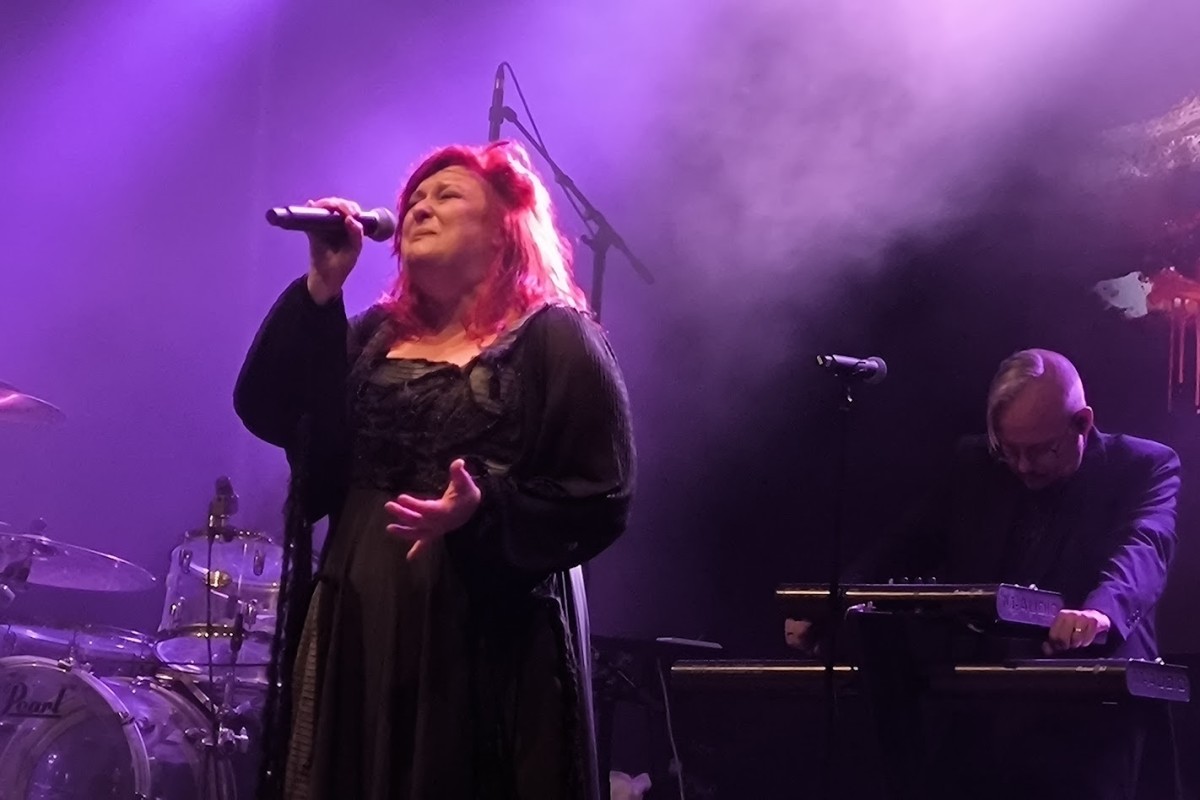
While the setlist explored numerous chapters of the band's illustrious career, special attention was given to Gezeiten, the landmark album released in 2004. Throughout the performance, the band created a darkly romantic atmosphere, enhanced by a powerful and remarkably clear sound that filled the festival grounds. Unfortunately, somewhere around the middle of the performance, the rain finally arrived. What had begun as little more than a drizzle soon developed into proper rainfall. Yet neither the weather nor the increasingly damp conditions diminished the band's impact. As always, L'Âme Immortelle delivered an intimate musical experience, woven from deep emotion, shifting atmospheres, and subtle, heartfelt touches. The response from the crowd was hardly surprising. L'Âme Immortelle have built a particularly strong connection with NCN Festival audiences through their regular appearances both here and throughout the surrounding region. Many fans knew every word by heart, singing along passionately and transforming the performance into something that felt genuinely communal, while the band remained entirely unfazed, delivering a thoroughly professional performance from beginning to end. As for us, we reluctantly retreated beneath the small roof of a nearby vendor stand, hoping the downpour would soon pass. Although quite a number of us squeezed under the tiny shelter, with water pouring down from its sides, it was impossible not to appreciate the band's commitment and the special atmosphere they had created. Rain-soaked, singing along, and refusing to let the weather spoil the occasion, the audience provided perhaps the clearest indication of all: nearly three decades into their career, L'Âme Immortelle remain as relevant, captivating, and beloved as ever".
Like most of the festival-goers, we had also come prepared for wet weather. However, our raincoats remained in the car, where they remain to this day, still in their original packaging. Hoping the rain would soon ease, we decided to wait for the performance of German wave and gothic scene veterans Girls Under Glass, who were due to take over the Amphi-Bühne at 22:45. We attempted to make our way there but, already quite soaked, gave up somewhere halfway and took shelter beneath the canopy of a jewellery stall, where, if nothing else, there was at least a little more room. Needless to say, we missed the concert, instead hoping we might at least catch the performance by French dark synth/electro artist Sierra Veins, scheduled for ten past midnight at the Park-Bühne. That hope died well before midnight. Now cold on top of it all, we were eager to reach our tent as quickly as possible and call it a night. We then proceeded to sleep for a full twelve hours. We would probably have managed even longer had we not been awakened at noon by the church bells of a nearby church.
Saturday, 5 September 2026
At least we woke up to a beautifully sunny, albeit slightly cooler, day. After spending some time relaxing outside the tent, we drove to the nearest grocery shop before heading to the Wald-Bühne, which between 14:30 and 15:20 belonged to South African-US gothic rock/darkwave outfit The Awakening. Unfortunately, Swiss-German electro duo SIIE were performing on the Park-Bühne at exactly the same time, a set we would otherwise have undoubtedly attended.
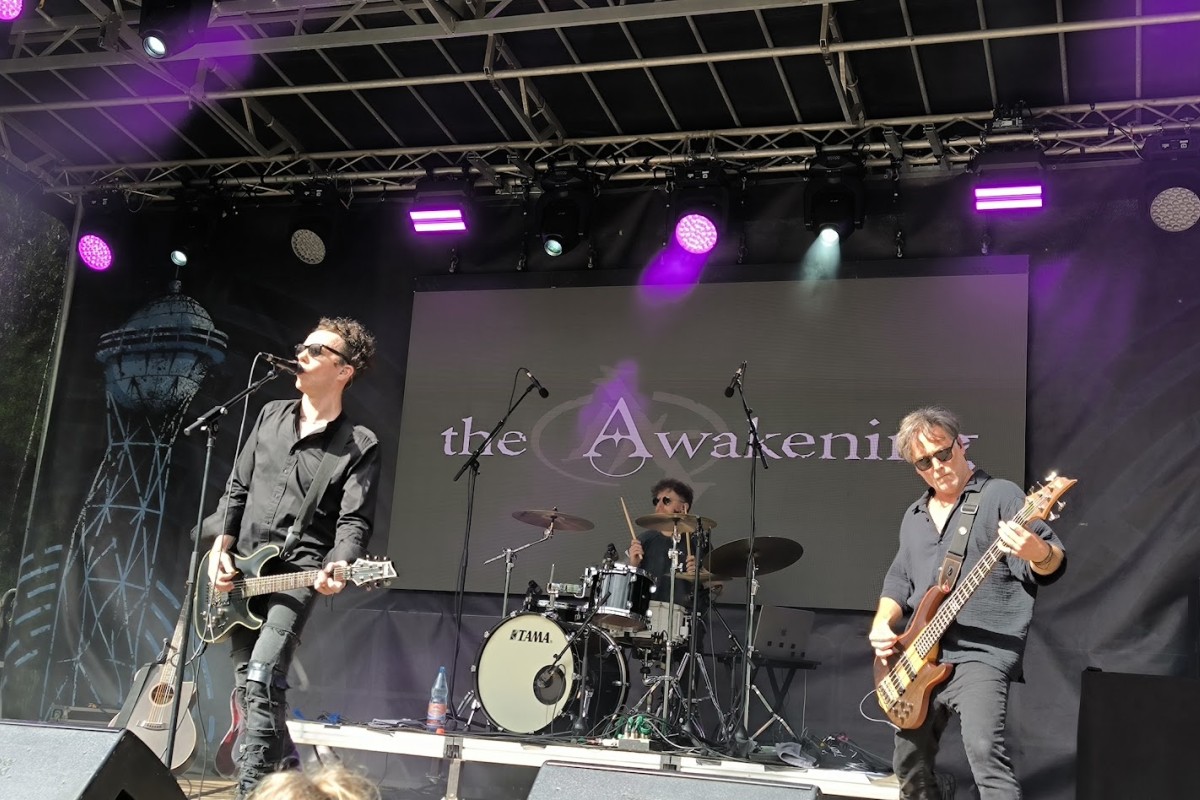
The Awakening took to the stage to the sounds of "Berlin", the atmospheric intro to their latest opus, The Lost Theatre, released in August. Another track from the album followed, the now undoubtedly familiar "Until The Dawn". The third song was supposed to be "Mirror Midnight", but we only got to hear its opening chord before technical issues intervened. Instead, an acoustic rendition of "Amethyst" arrived unexpectedly. I certainly didn't mind, as it's a beautiful older song that gains an extra touch of that elusive je ne sais quoi in its stripped-back form. It somehow suited the sunbeams spilling onto the stage: purple amethyst bathed in golden light. The band then treated the audience to "Indian Summer Rain", "Fault", "Haunting", "Nothing Like The Rain", The Lost Theatre's "Crystal Morning", and "Cabaret". The two rain-themed songs may have suited the occasion better at last year's Castle Party, when rain poured throughout The Awakening's entire performance, yet they once again proved to be among the highlights of the set. As in Poland, the performance concluded with the hit "The Dark Romantics", leaving me with the feeling that a few more dark romantics might have gathered had the event been held after dark rather than in broad daylight. The performance itself was wonderful, but it was missing some of the enchantment that only the night can bring.
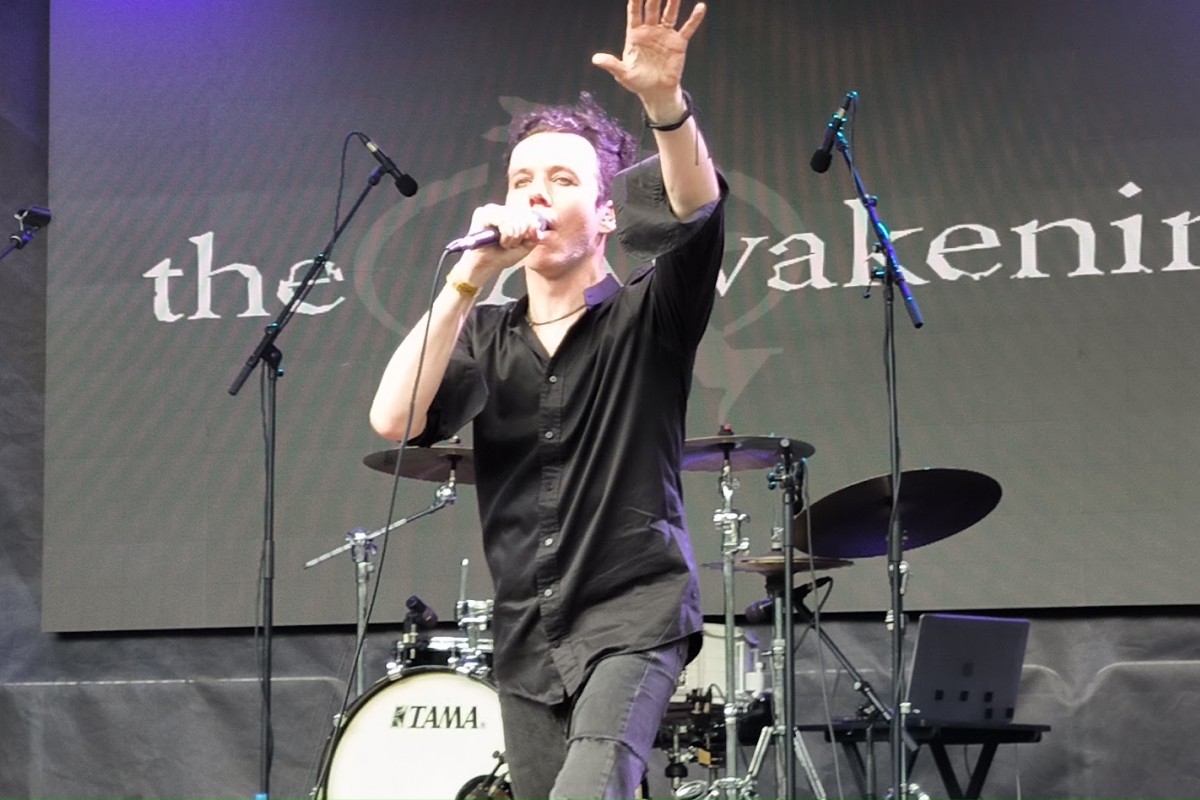
About an hour and a half after the concert, we met up with Ashton Nyte for an interview. His tour manager, Eva, led us along a wooded path behind the stage. After roughly a hundred metres, we reached a black van where Ashton was waiting for us. In films, scenes like this usually suggest some sort of illicit activity, but in this case it was simply an interview, which we conducted standing beside the van. At festivals without a press area, finding a suitable place for an interview can be something of an adventure, though by now we're quite used to it. As for the interview itself, we took a relaxed and entertaining look back at The Awakening's journey so far, and some other stuff.
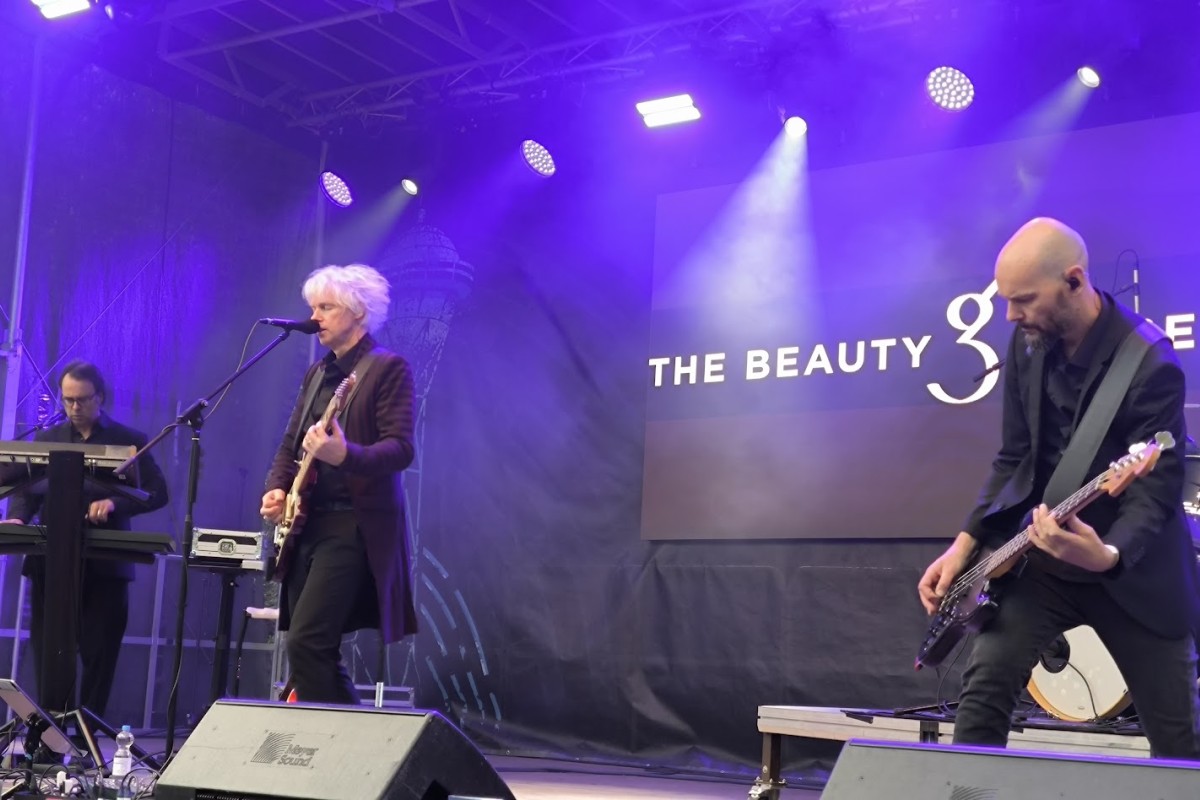
We didn't have much time to kill before The Beauty Of Gemina "beautified" the Wald-Bühne. Although the band didn't perform one of my personal favourites, "Running So Far", it was a wonderfully memorable experience nonetheless. Tomaz certainly felt the same, and here's the proof: "The Beauty Of Gemina were among the bands I had most hoped to see live at this festival. The Swiss outfit, led by Michael Sele, have been active since 2006 and have amassed an impressive catalogue of truly outstanding songs over the years, many of which I was eager to hear performed on stage. They opened with 'Dreams Of The Vagabonds' from their excellent latest studio album, Songs Of Homecoming, released two years ago, and it immediately became clear that this would be a very special performance. The superb sound mix allowed Michael's distinctive deep, velvety baritone, somewhere between Andrew Eldritch and Nick Cave, to shine even more brightly. Without a doubt, both his voice and his unique guitar work are central to the band's unmistakable identity. The Beauty Of Gemina delivered an elegant set filled with melancholy, atmosphere and genuine emotion. Eschewing unnecessary theatrics, they captivated the sizeable crowd gathered before the stage. Particular emphasis was placed on material from the cult classic Minor Sun and the aforementioned Songs Of Homecoming. We were also treated to songs from their early years, including 'One Step To Heaven', as well as the recently released single 'Endless Ever'. On a personal note, I was especially delighted to hear one of my favourite tracks, 'Endless Time To See'. I believe everyone fortunate enough to witness this concert would agree that it was an exceptional performance. Everything simply fell into place, making it one of the standout moments of the entire festival".
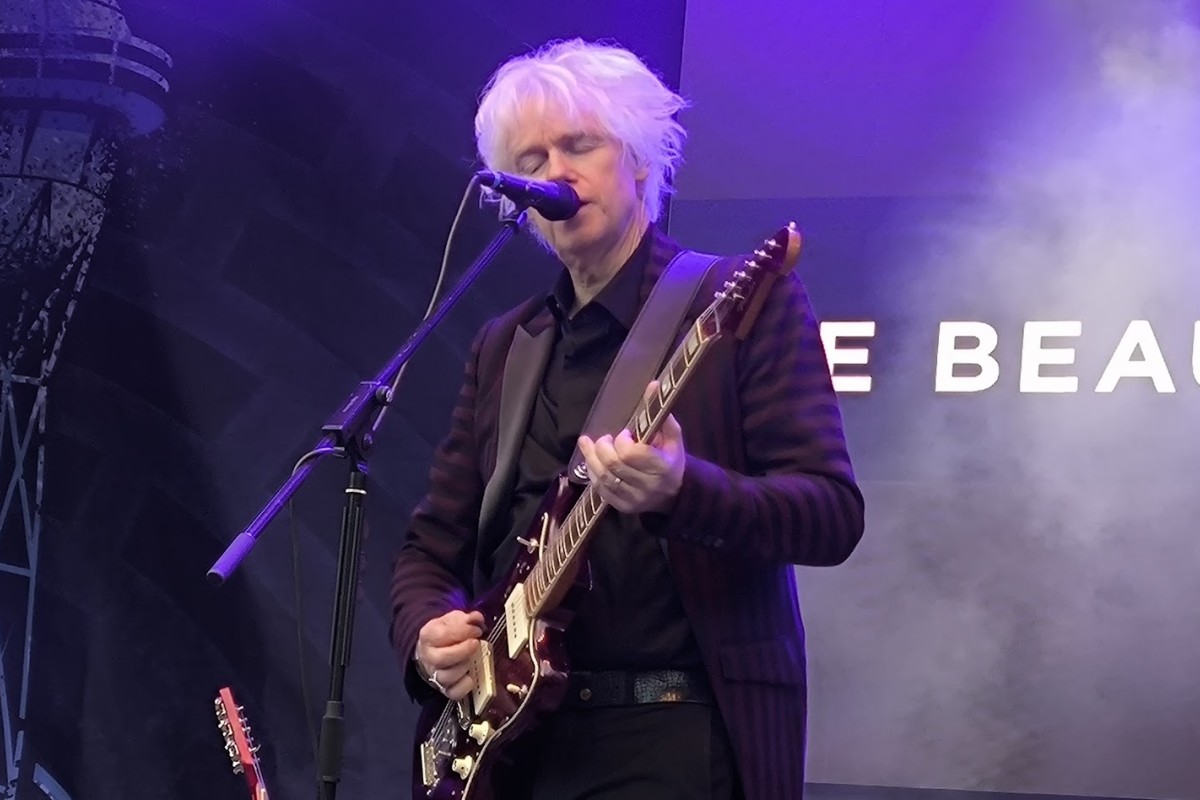
We then met up with Michael Sele for our interview. This time, we were invited backstage, probably because the band could extend their stay in the dressing room, with only SKYND left to perform on that stage afterwards. It was a pleasure to finally meet Michael in person and, yes, his voice is incredibly charming even when he's simply talking.
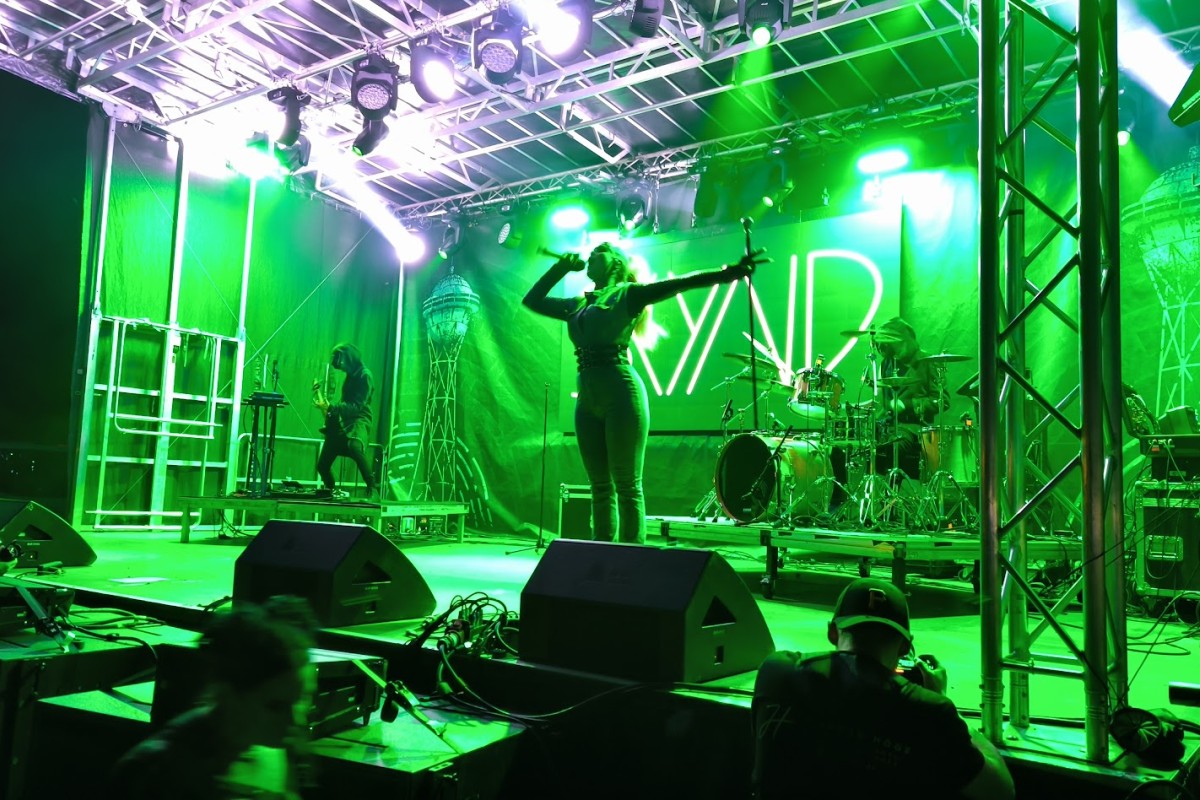
With our interview concluded, attention shifted to SKYND, who took to the stage at 21:00 for an hour-plus performance. The Australian duo are certainly one of the more unusual acts in the dark music scene. Consisting of vocalist SKYND and producer/multi-instrumentalist Father, they artfully combine industrial rock, dark electro, cinematic atmospheres, and elements of modern electronica and trap. What truly sets them apart, however, is their concept: nearly every song is inspired by a real-life crime, serial killer, cult tragedy, or another disturbing event drawn from recent history. SKYND thus brought to life a catalogue of true-crime narratives, including "Michelle Carter", "Elisa Lam", "Columbine", "Armin Meiwes", "John Wayne Gacy", "Edmund Kemper", "Jimmy Savile", "Mikhail Popkov", "Tamara Samsonova", "Jim Jones", "Gary Heidnik" (the Jonathan Davis collaboration that helped bring the duo wider recognition), and "Tyler Hadley". The performance also featured the live debut of "Johnny Kitagawa".
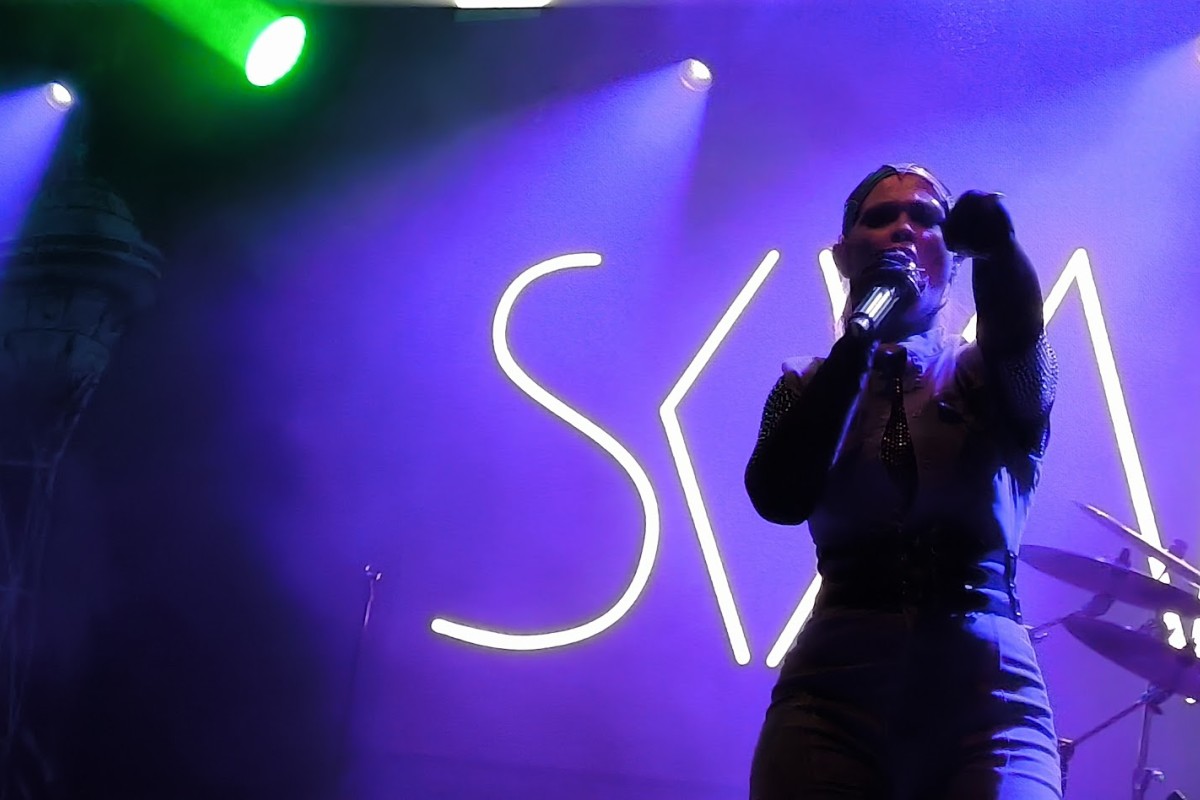
Accompanied by dramatic lighting and unsettling visual imagery, all thirteen tales were brought to the stage with remarkable conviction. With her unusual vocal range, shifting from whispered passages to aggressive, almost inhuman sounds, and her exceptional stage presence, expressive gestures, and facial expressions, SKYND delivered each one to perfection. One can only wonder what direction the project will take once it exhausts its catalogue of dark and disturbing source material. Judging by humanity's track record, however, SKYND are unlikely to run out of inspiration any time soon.
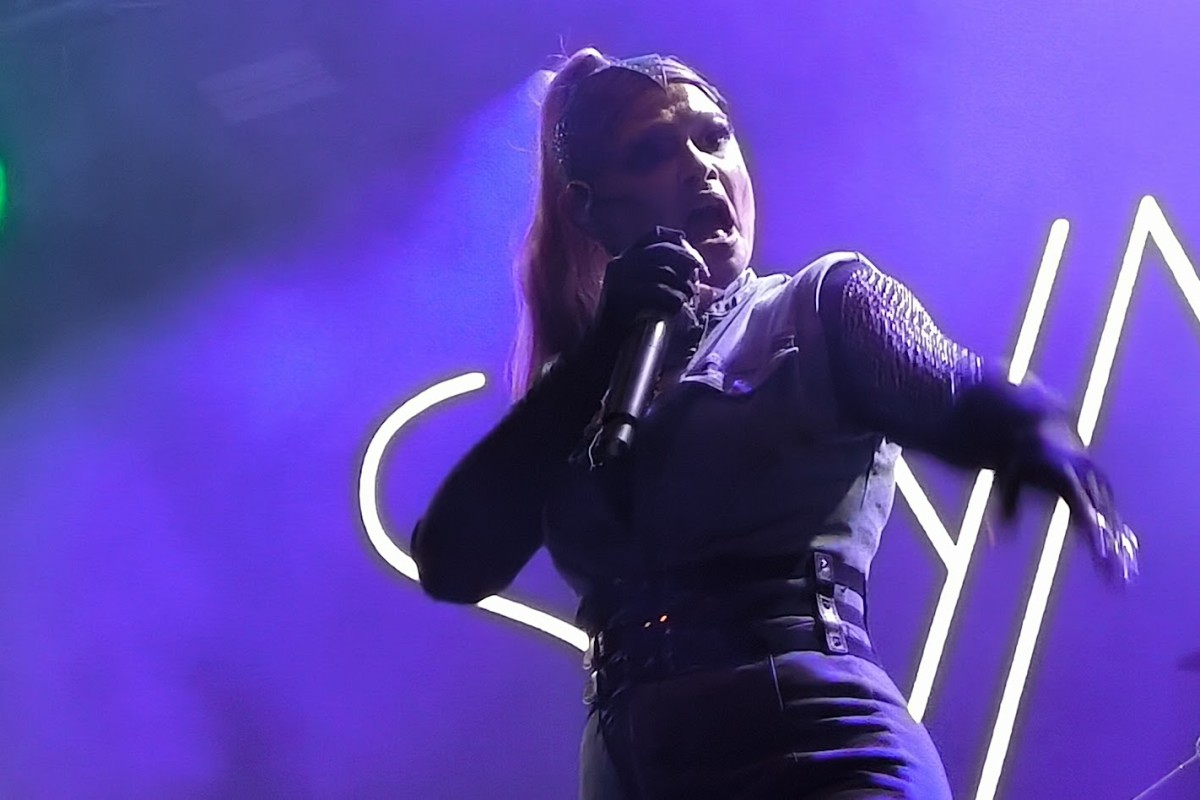
By the end of the festival, it had become clear to me that SKYND had delivered by far the most powerful performance of this year's NCN. Before arriving at that conclusion, however, there were still a few more performances to catch.
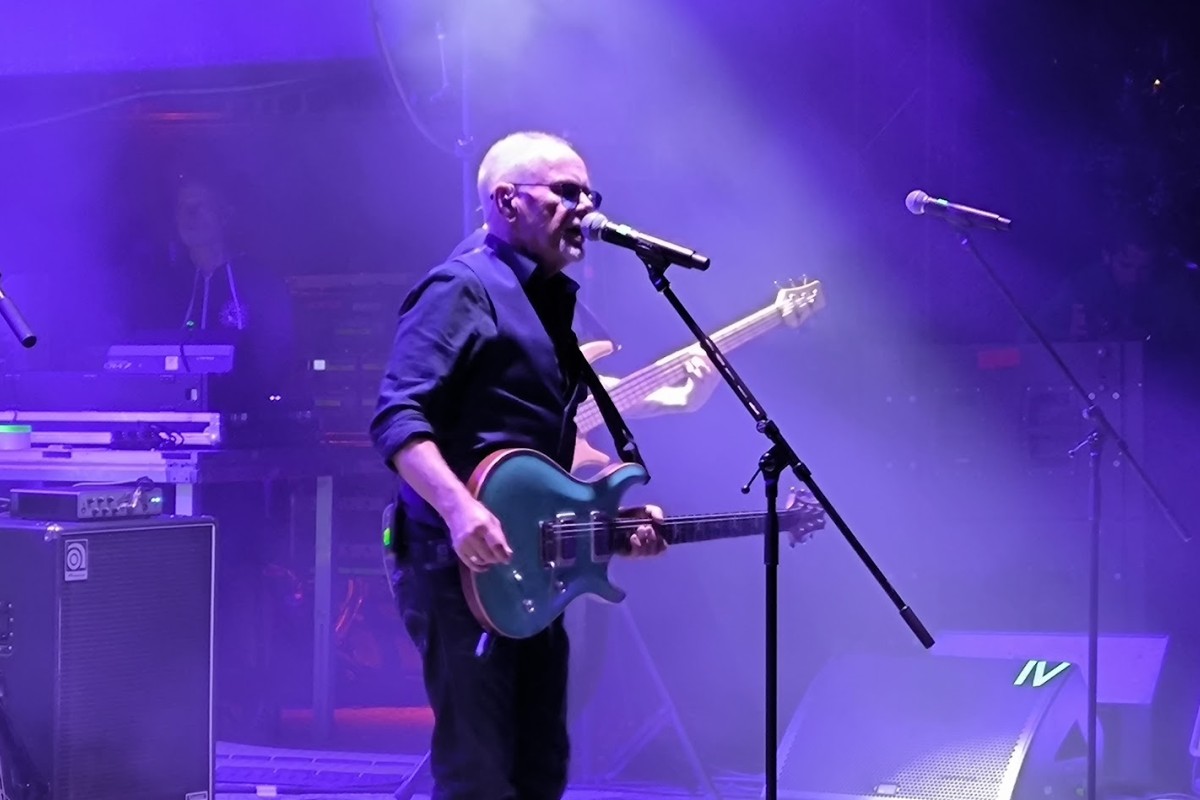
First up was Nik Kershaw, who took to the Amphi-Bühne at 22:30. One of the biggest British pop stars of the mid-1980s, he rose to fame with hits such as "Wouldn't It Be Good", "I Won't Let The Sun Go Down On Me", "The Riddle", "Wide Boy" and "Don Quixote". He definitely drew a sizeable crowd, with the venue packed to the very last corner, although a large proportion of those in attendance had probably made their way to the festival specifically to see him. We headed there largely because of his name and, perhaps, in the hope that his music might resonate with us a little more now that we're older. It didn't. After sitting through just the first three songs ("Come On Down", "Wide Boy" and "When A Heart Beats"), we decided that a drink sounded far more appealing and headed off to await Lone Assembly at the Park-Bühne, which Tomaz summed up as follows: "Swiss post-punk/synth-pop quartet Lone Assembly first came onto my radar earlier this year when, following a string of singles and a 2024 EP, they released their debut album, Knots & Chains, in February. Performing on the smaller Park-Bühne stage, the band delivered almost their entire catalogue, playing virtually all of the That Never Happened EP while understandably placing the main focus on Knots & Chains, from which eight songs were featured.
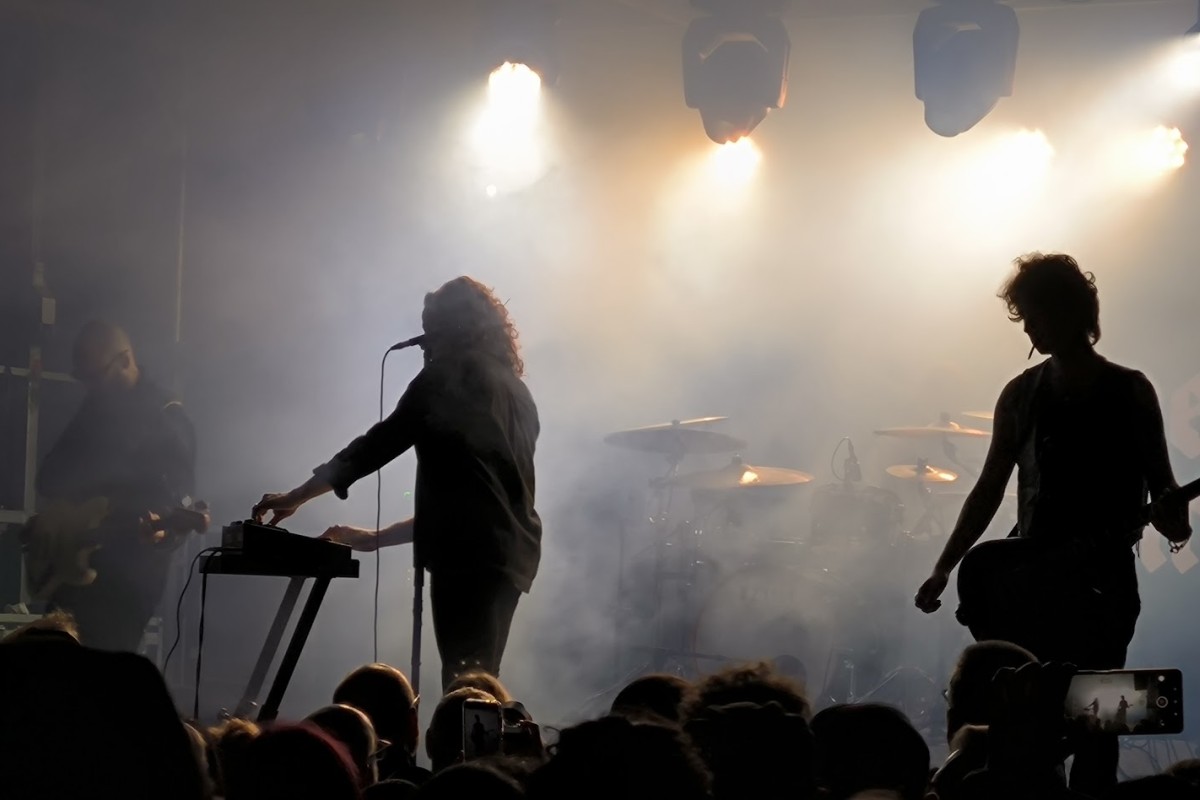
As for the performance itself, it felt very much like watching a band in a packed club rather than at an open-air festival. Their blend of new wave, post-punk, synthwave, and alternative rock creates a pleasant and immersive atmosphere, perhaps at times even a little too laid-back. The late hour may have played a part, but I never quite connected with the energy of the set. Frontman Raphaël Bressler, handling both vocals and keyboards, was the only member who made a noticeable effort to engage the audience, and to a certain extent he succeeded. However, the rest of the band appeared somewhat static on stage. Bressler's vocal delivery is rather distinctive and, in certain passages, even brought to mind Michael Sele of The Beauty Of Gemina, whom we had seen perform just a few hours earlier. That said, the show was by no means disappointing. If anything, it may have felt slightly too long for such a late slot, with the band performing around thirteen songs in total. The sound quality was excellent, and those who still had enough energy left danced to the band's dark, wave-infused melodies and rhythms right through to the end".
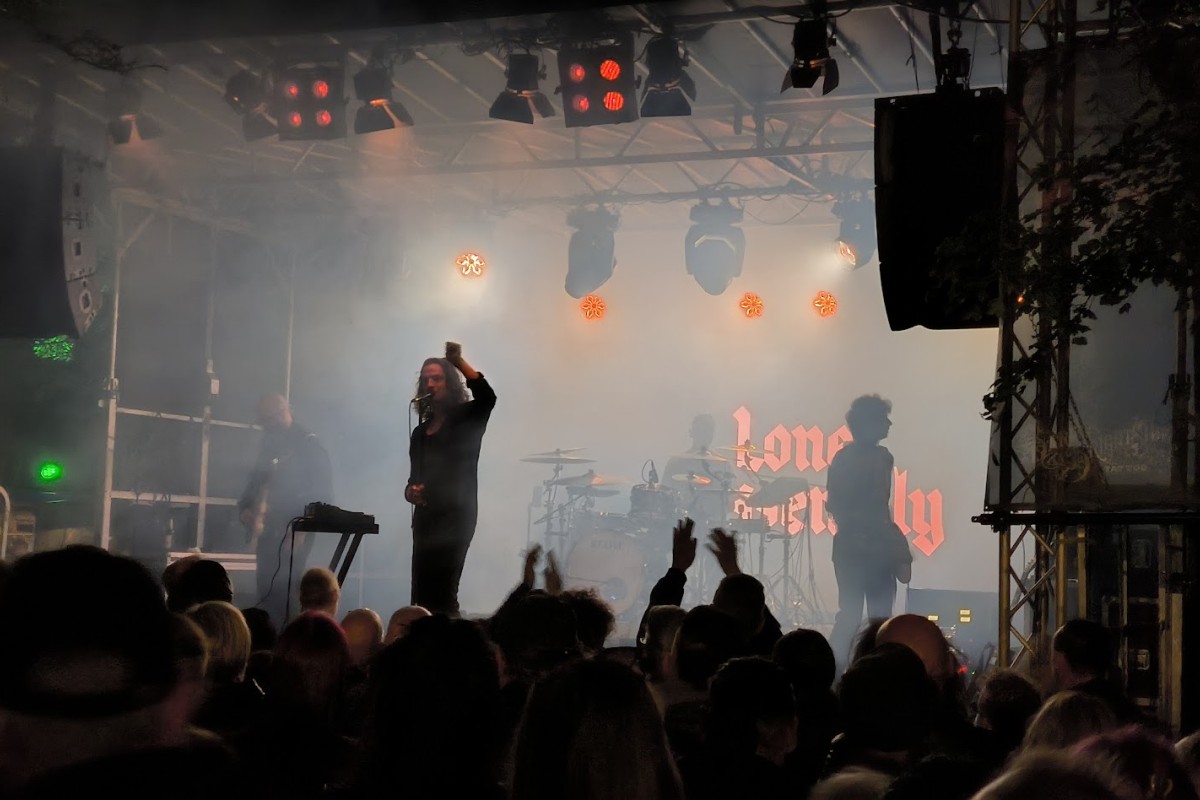
Lone Assembly brought another festival day to a close for us. With one more day still ahead, we called it a night and headed off to sleep.
Sunday, 6 September 2026
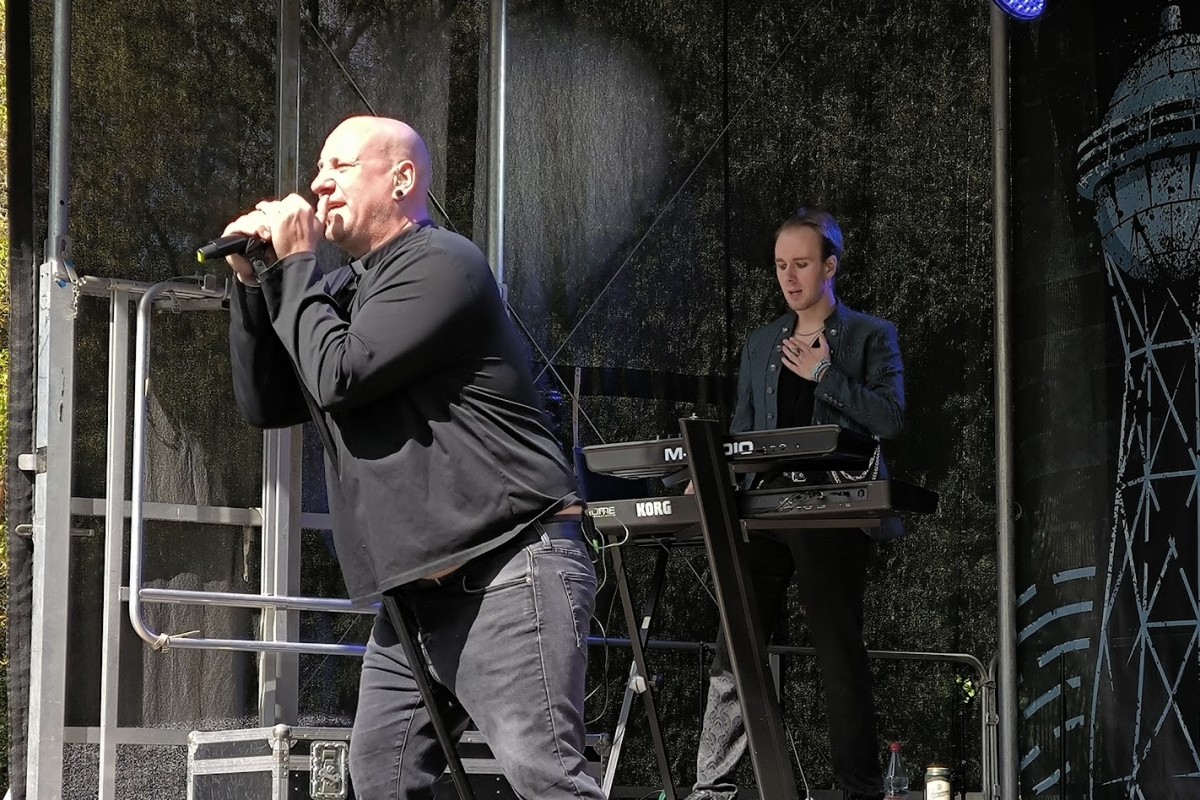
Sunday's programme got off to a rather underwhelming start. Beyond Border, who occupied the Wald-Bühne for half an hour from noon onwards, proved, at least for me, quite disappointing. Of the seven songs they performed, "Number 23 (Club Version)", "Prayer", "Jump Into The Fire", "Construction", "United" (an In Good Faith cover), "What Makes The World Go Round", and "Simplify", not a single one came across as convincingly as it should have. The vocals and the music seemed to exist on entirely different wavelengths. Despite this, the moderately sized crowd enthusiastically sang along to many of the songs, and I found myself rather puzzled by their enthusiasm. Moreover, all that jumping about that Iggi did on stage, apart from during "Jump Into The Fire", where it at least made thematic sense, seemed somewhat out of place. I don't know, I like their music, but this was easily the weakest performance I witnessed at this year's festival.
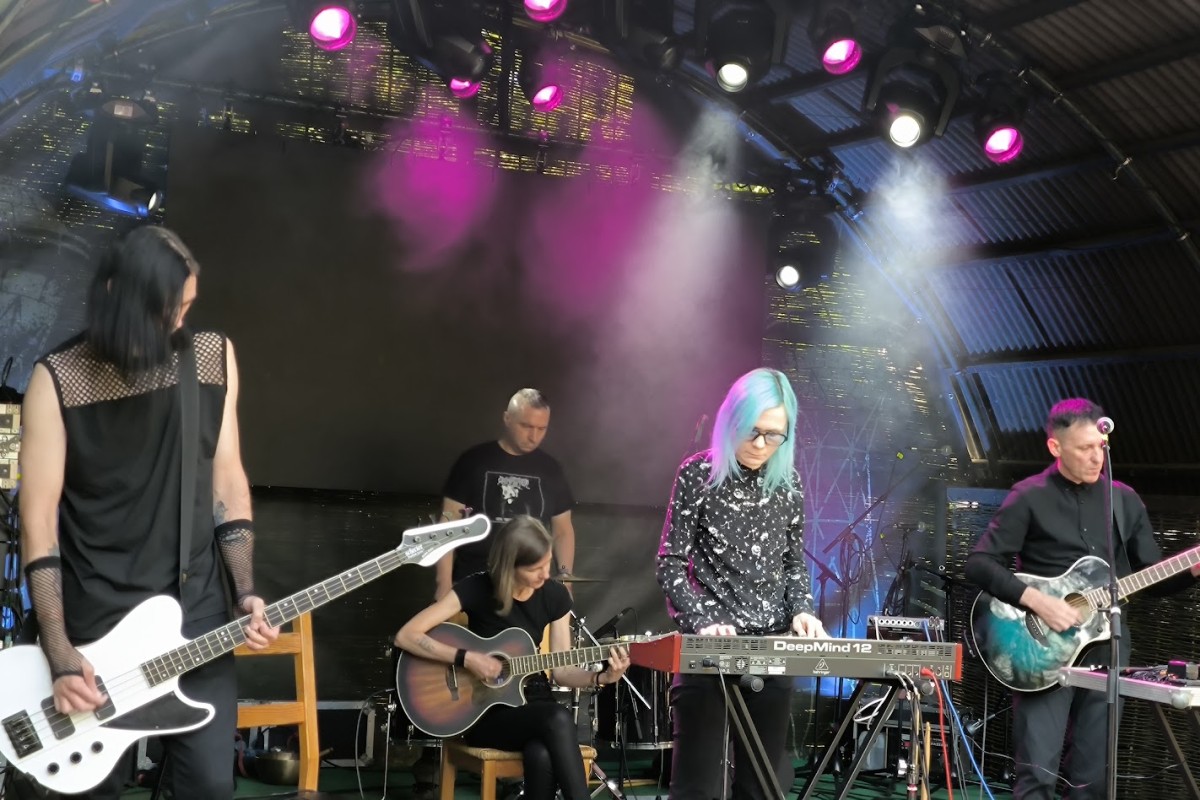
We briefly made our way over to the Kultur-Bühne, where Hungarian neofolk outfit Cawatana had already begun their set. Here is how Tomaz saw it: "Cawatana delivered a performance that felt perfectly suited to one of NCN's smaller yet more intriguing venues. Up until now, I had never paid the band a great deal of attention. While I was familiar with them to a certain extent, their blend of dark folk, neofolk, minimal wave, and post-punk had never particularly resonated with me. I must admit, however, that I found this performance genuinely engaging. The three men and two women from Hungary presented a concise acoustic set comprising just eight songs, half of them drawn from their debut album, Struggle For Wisdom (2003). Several of these tracks, including 'Real, Open' and 'Oh, Cheerful Days Come', reappeared in reworked form on last year's Beyond The Glory.
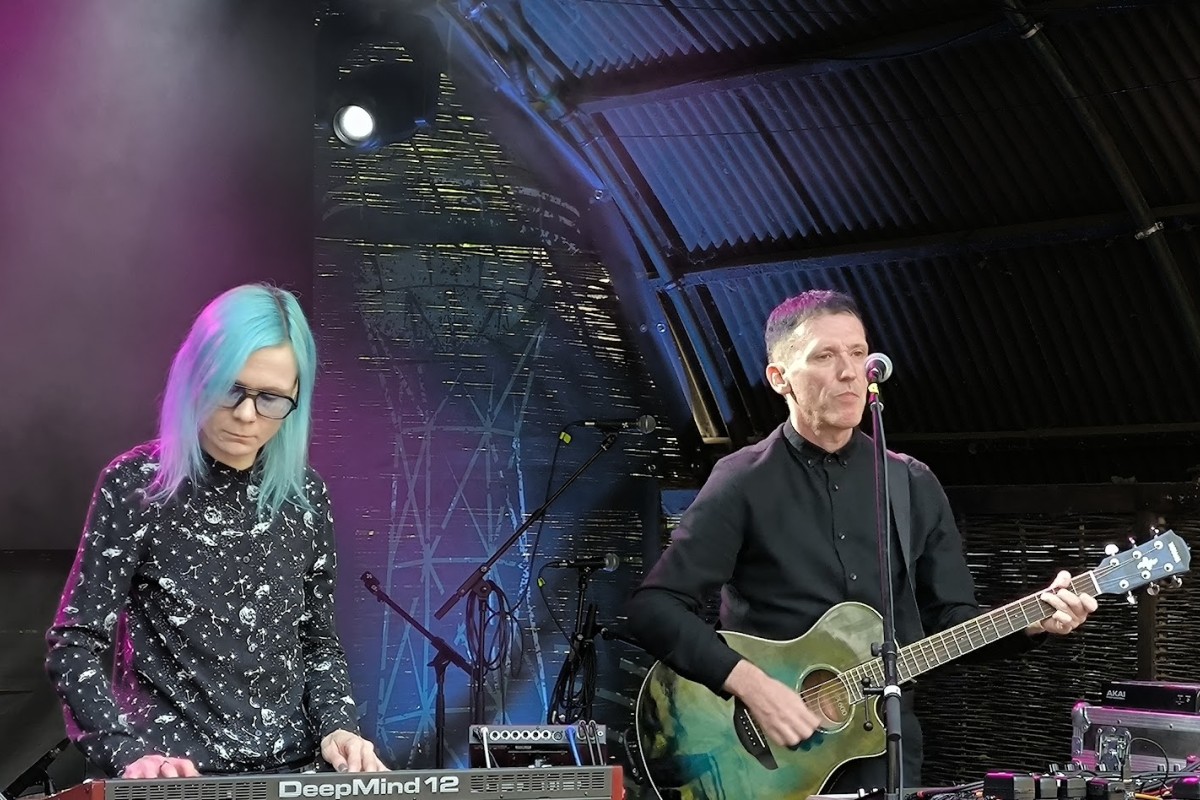
'Something In The Final Hour' came from Comprende (2016), while the somewhat post-punk-inflected 'May' originally featured on Various (in Space and Time) (2008). As for the performance itself, this may not ordinarily be my preferred style of music, yet in that particular setting it worked remarkably well, aided greatly by both the excellent sound and the intimate atmosphere. The band remained deeply absorbed in their music throughout, with little direct interaction with the audience, something that actually felt entirely fitting given the traditions and aesthetics associated with the genre. They conjured a distinctive atmosphere with a subtle medieval flavour, gently drawing the crowd into a collective sway and earning warm, enthusiastic applause in return".
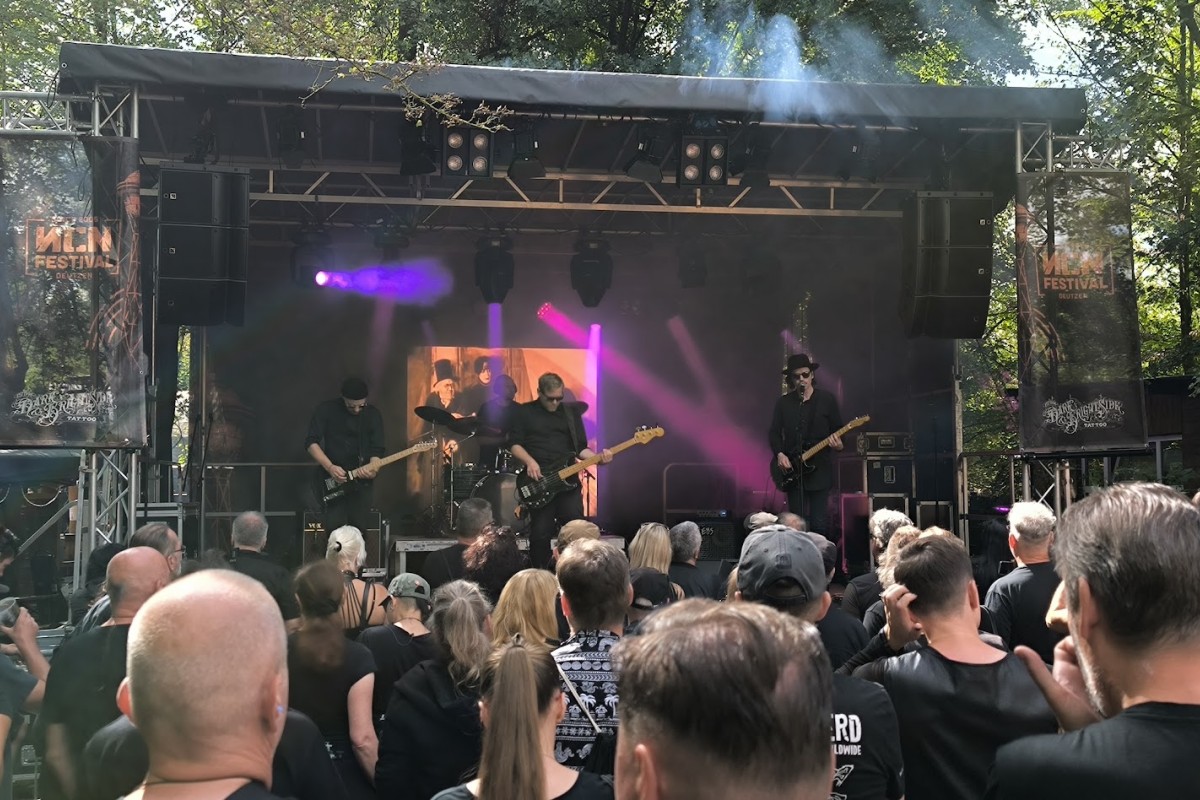
Half an hour later, the Wald-Bühne welcomed Belgian gothic/synth-rock act Lovelorn Dolls, while Norwegian post-punk/dark romantic outfit Mayflower Madame were about to begin their set on the Park-Bühne. With both bands performing simultaneously, we were faced with an inevitable dilemma. In the end, we opted for Mayflower Madame, planning to return later and catch the remainder of Lovelorn Dolls' slightly longer set.
Tomaz summarised both performances as follows: "I first came across Mayflower Madame six years ago when they released Prepared For A Nightmare. Their melodic, slightly dreamy, romantic, shoegaze-infused, and detached brand of post-punk immediately drew me in and kept me returning for repeated listens. That fascination only grew stronger towards the end of 2024 with the release of the excellent album Insight. Naturally, they were high on my list of must-see acts at this festival. Their performance reminded me somewhat of Lone Assembly's set the previous day, perhaps partly because it took place on the same stage, the Park-Bühne, although Mayflower Madame were performing in broad daylight. As expected, they devoted most of their brief half-hour set to Insight, from which they played four songs.
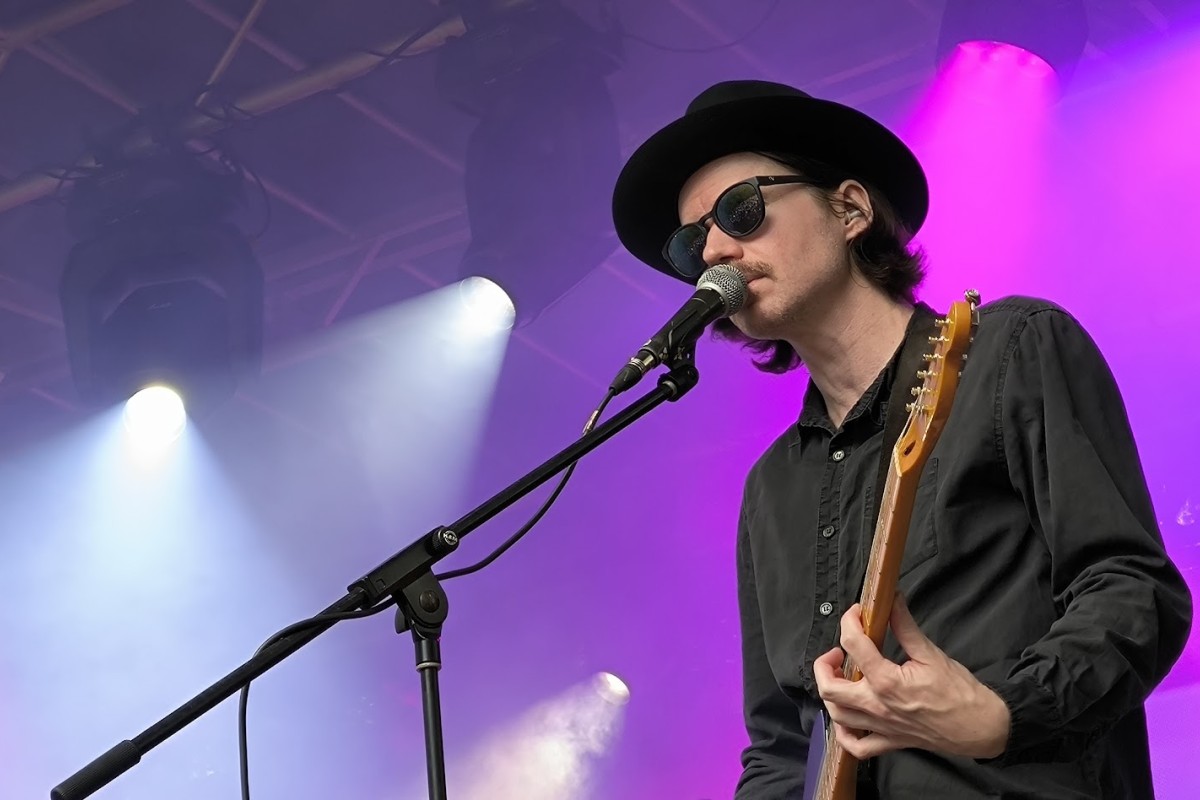
They also dipped into their earlier catalogue from the outset with 'Confusion Hill', taken from their 2016 debut Observed In A Dream, followed immediately by 'A Future Promise' from the aforementioned Prepared For A Nightmare. Bathed in purple light and artificial fog, Mayflower Madame conjured a dark, subtly psychedelic, hypnotic, and romantic atmosphere that perfectly complemented their floating sound. The remainder of the set focused on material from Insight. Even so, I must admit that I had expected somewhat more from the performance. The sound was excellent, yet the band appeared rather static, as though lacking a certain spark. Then again, considering the nature of their music, such a restrained stage presence somehow suited them. Nevertheless, it was by no means a disappointing performance, and I would still very much like to see Mayflower Madame play a longer, full-length set one day. Unfortunately, Jerneja and I had to leave before they performed the outstanding 'A Foretold Ecstasy', as we wanted to catch at least part of Lovelorn Dolls' show on the Wald-Bühne. Having missed Lovelorn Dolls at Castle Party the previous year, catching at least a portion of their set this time felt almost essential. As many will know, the band's co-founder, Bernard Daubresse, passed away last autumn, and fellow co-founder Kristell 'Ladyhell' Lowagie decided to continue the band's musical journey.
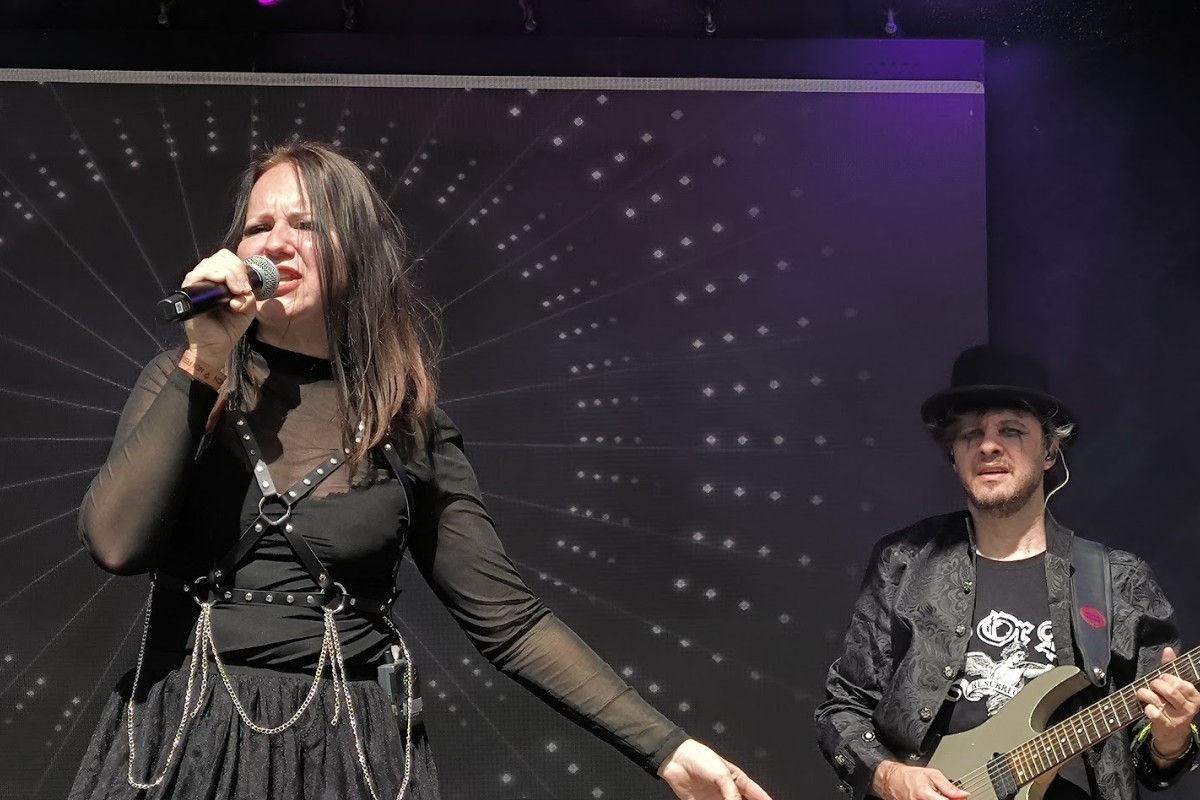
At NCN, Lovelorn Dolls performed as a duo consisting of Kristell and guitarist Eric Renwart. Unfortunately, there is not a great deal I can say about the performance itself, as Jerneja and I only managed to catch three songs. As a result, we were unable to fully immerse ourselves in the fairytale-inspired atmosphere that Lovelorn Dolls, much like The Birthday Massacre, seek to create through their music. What surprised me most was the relatively small crowd gathered in front of the stage. In my opinion, however, this was largely due to the unavoidable overlap between performances across the festival's various stages.
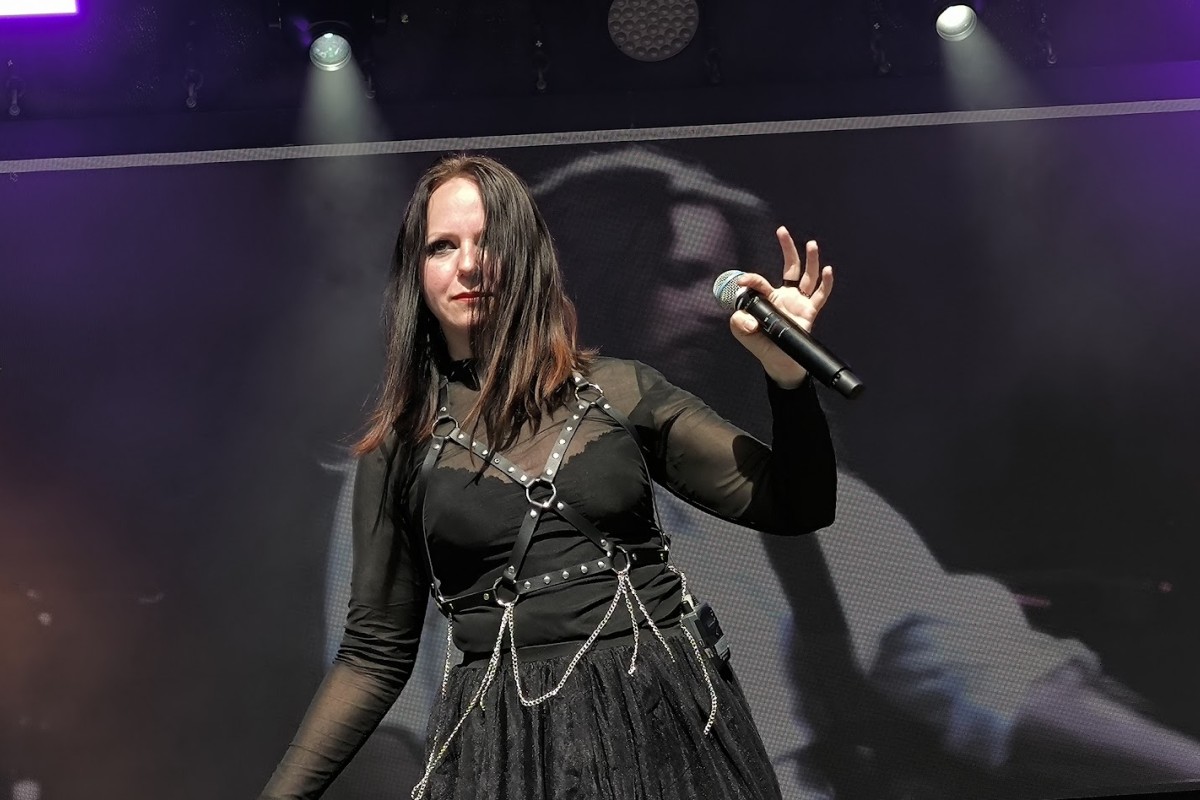
Despite this, Lovelorn Dolls gave their all and delivered a committed set. That said, I could not help feeling that they might have been better suited to one of the festival's smaller stages. As a duo, they occasionally seemed somewhat lost on the larger platform, despite their efforts to engage the audience. The sound was fairly solid overall, but lacked some of the energy and impact needed to make the performance truly compelling. Despite the band's lively stage presence, Kristell's expressive vocals, and Eric's weighty guitar work, the songs themselves lacked the memorable peaks necessary to fully elevate the set, leaving parts of it feeling somewhat underwhelming. In many ways, Lovelorn Dolls' electronically infused gothic rock is perhaps best experienced within the more intimate confines of a club venue. Towards the end of the set, during what I believe was 'Broken Dreams', the duo paid a touching and heartfelt tribute to the recently departed Bernard Daubresse. It was a moving moment that clearly resonated with those in attendance and provided an emotional conclusion to the performance."
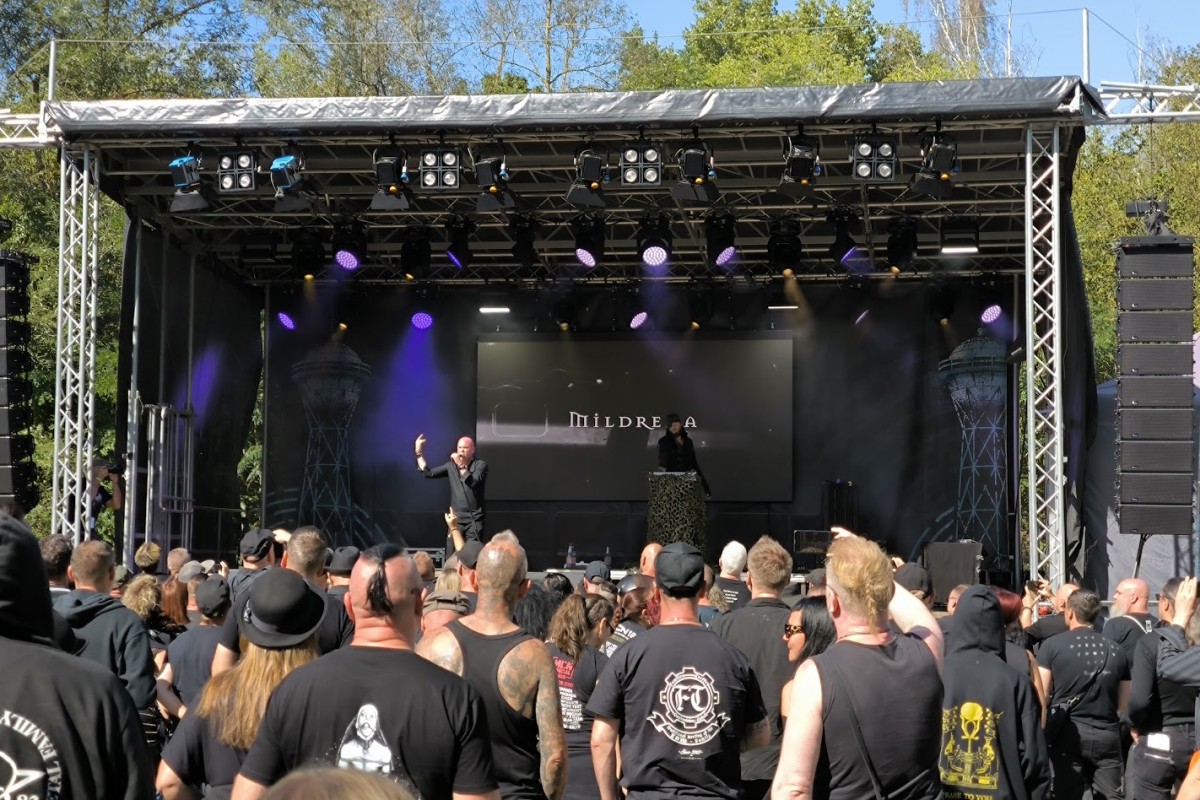
We spent the next 40 minutes at the Wald-Bühne, eagerly awaiting the performance of Belgium's dark electro duo Mildreda. Tomaz later summed up their nearly hour-long set as follows: "Yet another band that was simply too difficult to miss, despite having to choose between them, the equally impressive The Foreign Resort performing simultaneously on the Park-Bühne, and Mildreda on the larger Wald-Bühne. With the recently released Realities and its excellent predecessor Blue-Devilled still fresh in my mind, I was particularly eager to see Jan Dewulf's Mildreda perform live. The question was whether the band could recreate at least some of the emotions and atmosphere so vividly conveyed on their records. I must admit I was somewhat sceptical. Performing on a larger stage requires a certain degree of experience and charisma to win over an audience, and in my experience very few duos or solo acts manage to do so successfully. Fortunately, Mildreda rose to the challenge admirably. Admittedly, some of the mystique that permeates their albums inevitably dissipates when the afternoon sun is beating relentlessly down on the stage.
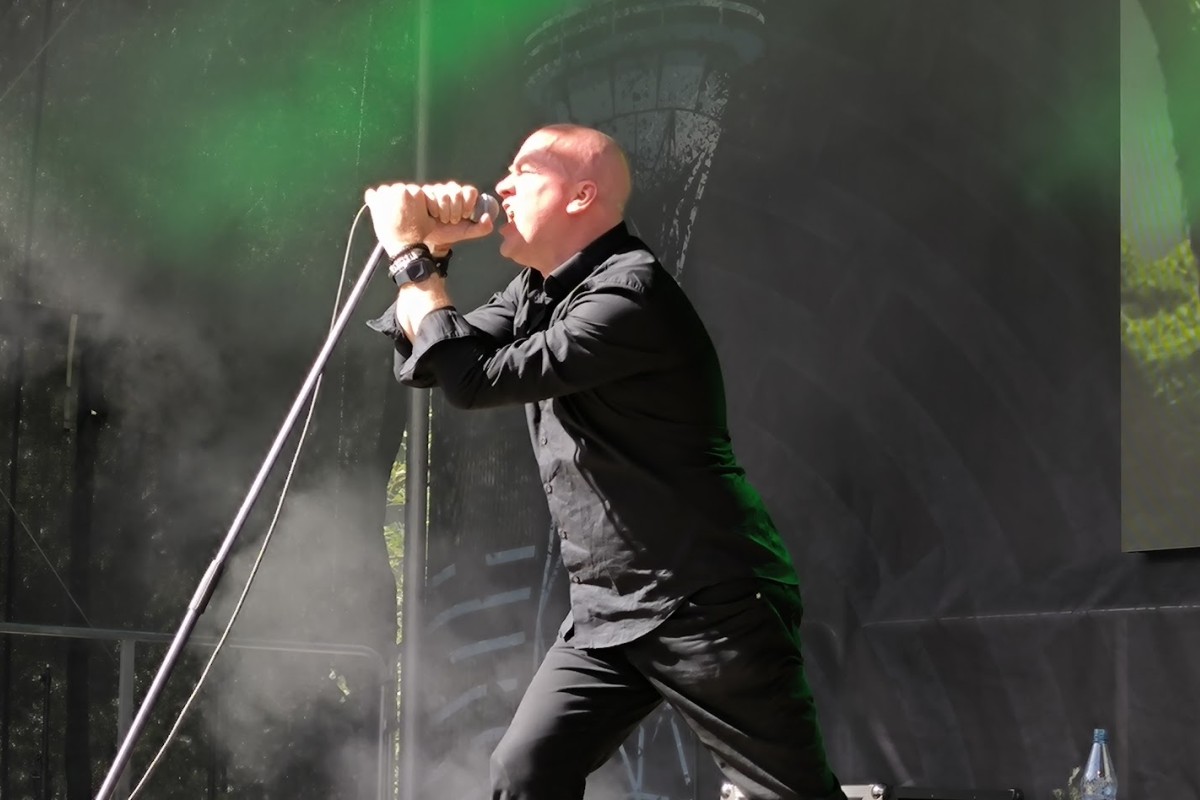
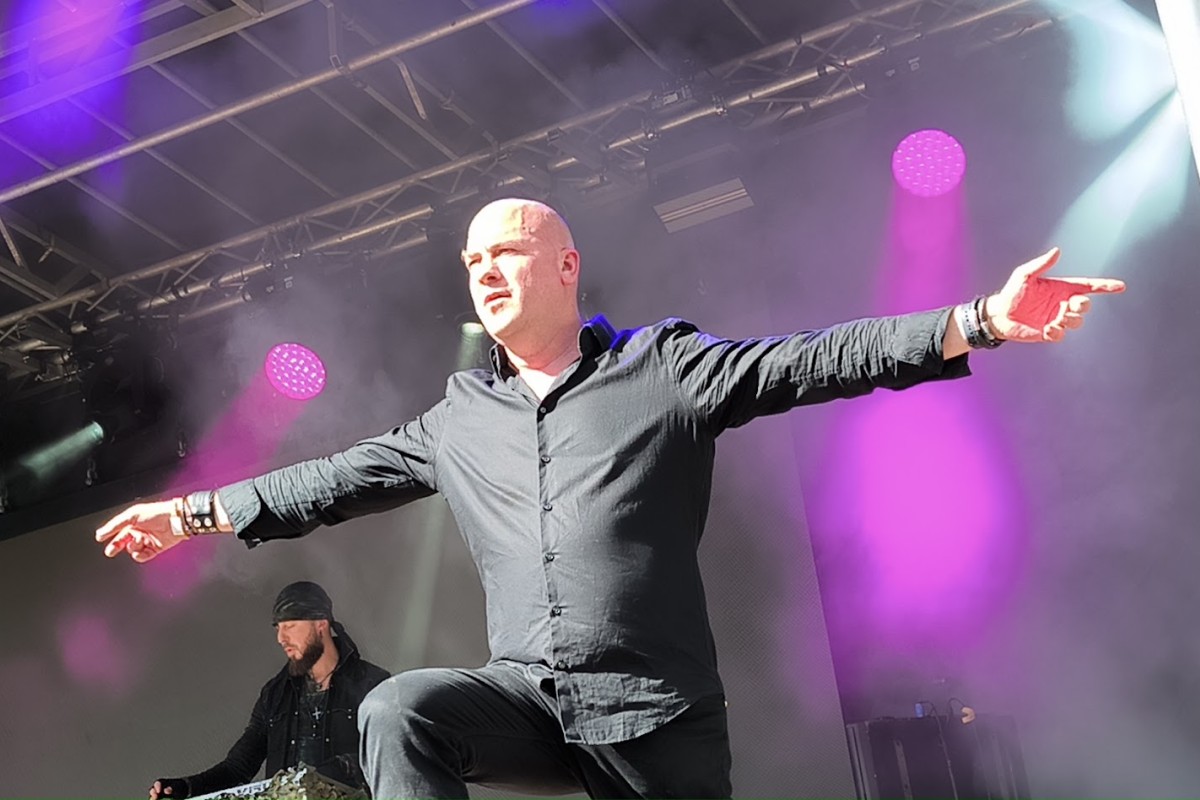
However, Jan and keyboardist Christophe Salvatore are seasoned performers, capable of creating a compelling atmosphere regardless of the circumstances. They were further aided by a strong, well-balanced sound mix, something essential for Mildreda's multidimensional blend of cinematic, emotionally charged, suspenseful, ambient, and cold electronic music to achieve its full impact. Jan proved himself a confident and engaging frontman, guiding the audience through a set that, in just under an hour, struck an effective balance between newer material and older favourites. As an added bonus, the band treated the crowd to a cover of Project Pitchfork's "The Refuge". A sizeable audience had gathered in front of the stage and, judging by the enthusiastic response, many were clearly impressed by what they heard and saw. I do not wish to repeat myself, but I cannot help feeling that Mildreda would benefit greatly from a late-night slot. Personally, I would love to see them perform in a smaller club setting, where the atmosphere, intensity, and emotional depth of their music could truly flourish. Even so, this was a very strong performance, one that undoubtedly left a lasting positive impression".
At 17:00, we met up with Jan Dewulf (Mildreda, Your Life On Hold) for an interview. Once we had gathered, we began searching for a suitable place to talk. Tomaz suggested a somewhat secluded corner with a few tables and benches, although all of them were already occupied. In the end, we joined the least crowded table and, after barely ten minutes of conversation, somehow managed to drive away the two people who had already been sitting there. Whether our discussion was really that unbearable remains an open question. As for me, I thoroughly enjoyed our conversation and, once the interview is published, you'll be able to enjoy most of it as well. Naturally, a few topics remained off the record.
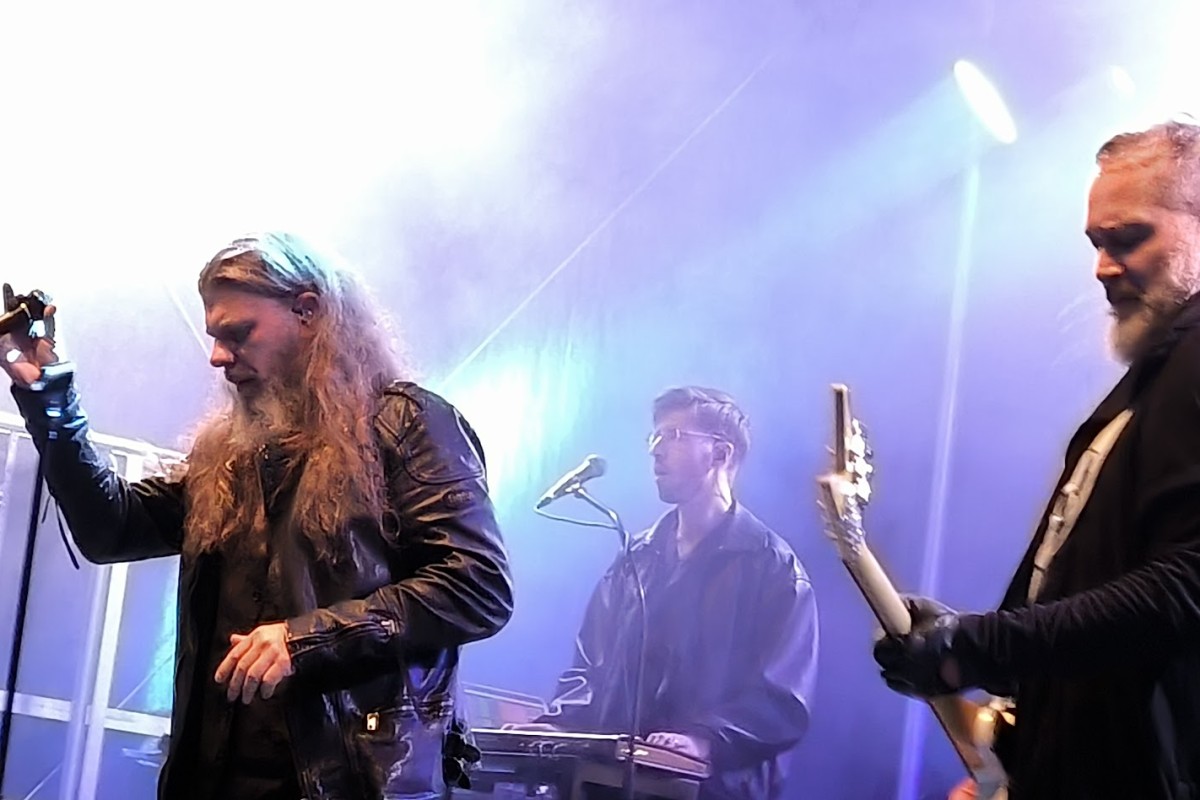
With a little over an hour remaining before Diary Of Dreams brought the Wald-Bühne programme to a close, we spent much of the time simply wandering around. Dusk was already settling over the site when the atmosphere on and in front of the stage began to stir once again. This time, more noticeably than before the other performances we attended at this venue, either because Diary Of Dreams had drawn the largest crowd or because so many devoted fans were present, who would go on to perform the role of an unofficial sixth band member throughout the entire set. The band opened with the more recent "The Chemistry Of Pain" before moving on to several tracks that have become staples of their setlists in recent years: "Viva La Bestia", "The Secret", "Endless Nights" and "Undividable".
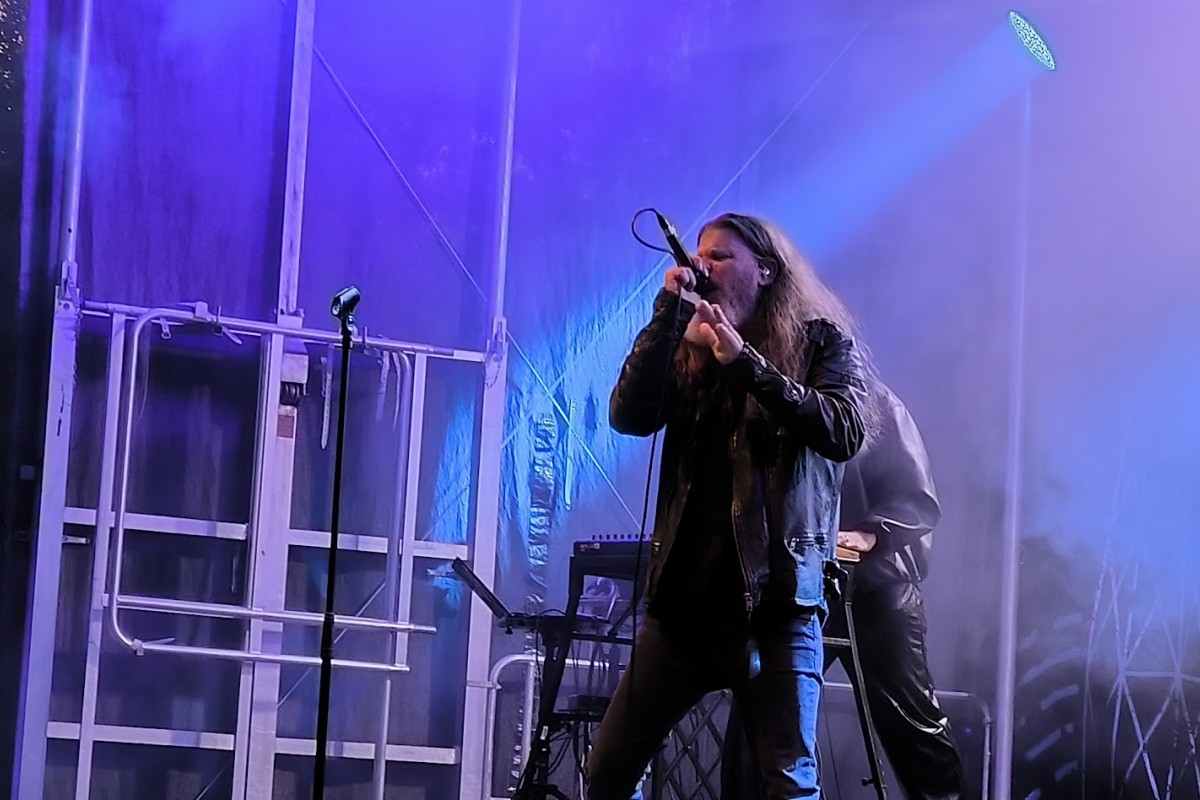
I did not pay much attention to what was happening on stage. Instead, I chose to sit at a nearby table and simply listen. It was seventy-five wonderful minutes. Older and newer songs came together as a remarkably cohesive whole, one with a story of its own. For me, Diary Of Dreams provided the festival's most profoundly personal concert experience. I know I previously said that SKYND delivered by far the most powerful performance at NCN, and they did, viewed from a broader and more objective perspective. Diary Of Dreams, however, resonated on a far more intimate level. Everything came to an end with "Traumtänzer", a song that has become a regular closing number in their recent live performances. Whether every audience is given the opportunity to sing part of a song in unison, I cannot say. This audience certainly was, and they delivered their part so flawlessly that any choir conductor would have been delighted by such precision at a first rehearsal. Yet it was the tenderness in their voices that truly sent shivers down my spine.
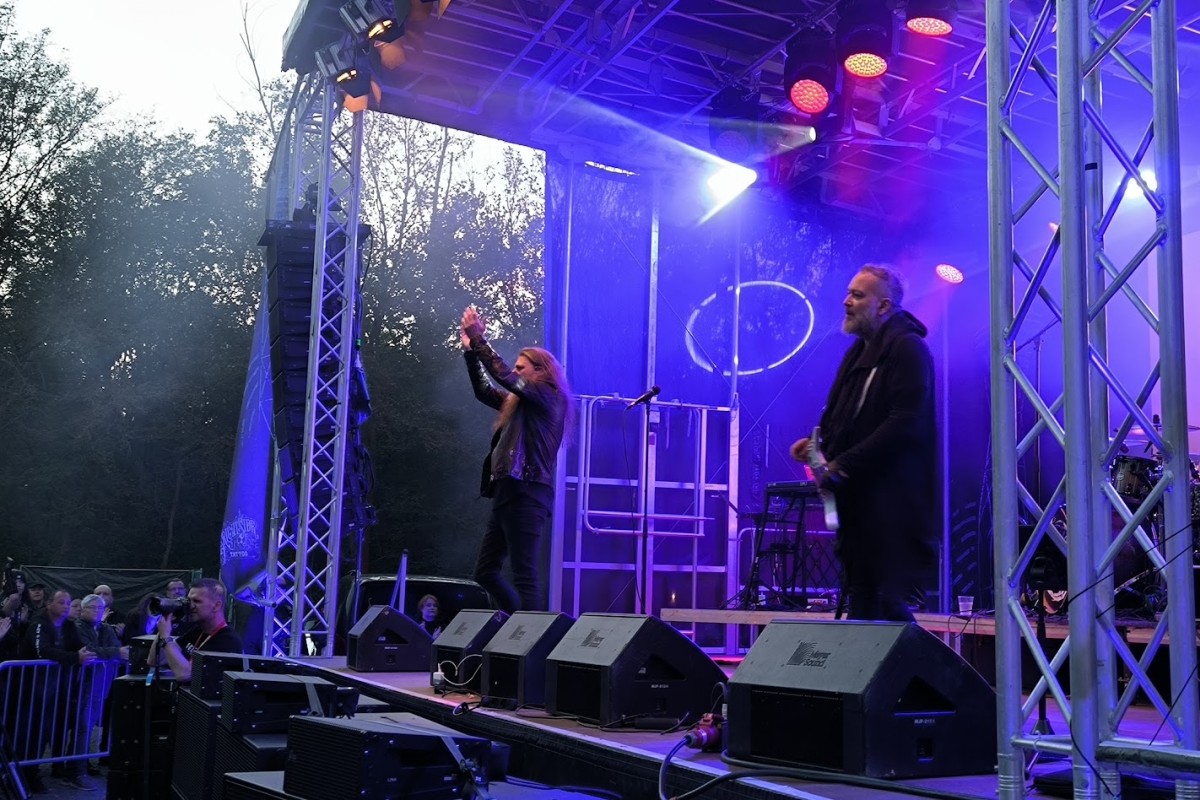
It would have been lovely to end the day with such a beautifully performed lullaby, but Die Krupps had other ideas, delivering a powerful wake-up call instead. We missed the first three or four songs, or rather listened to them from a nearby food stall while tucking into some rather peculiar baked potatoes with an even more peculiar accompaniment. God only knows what was in it, but it did the job, and with our stomachs finally lined, we set off in search of one final dose of the festival. Tomaz received it like this: "The honour of bringing this year's festival to a triumphant close fell to German industrial rock and metal pioneers Die Krupps. Active since 1980, the band have released eleven studio albums and made an immense contribution to the development of the industrial genre as a whole. Unfortunately, we missed roughly the first quarter of their set, but what we did manage to see was more than enough to provide a fitting finale to the festival. The Amphi-Bühne, the festival's largest stage, was packed to capacity, and the atmosphere crackled with anticipation. The performance was everything one could hope for from Die Krupps: energetic, hard-hitting, powerful and, above all, flawlessly executed. It was immediately apparent that the band possess decades of experience and feel completely at home on a stage of this scale. Their trademark fusion of industrial rhythms, heavy metal riffing and EBM-infused grooves created an irresistible momentum that carried the set from start to finish.
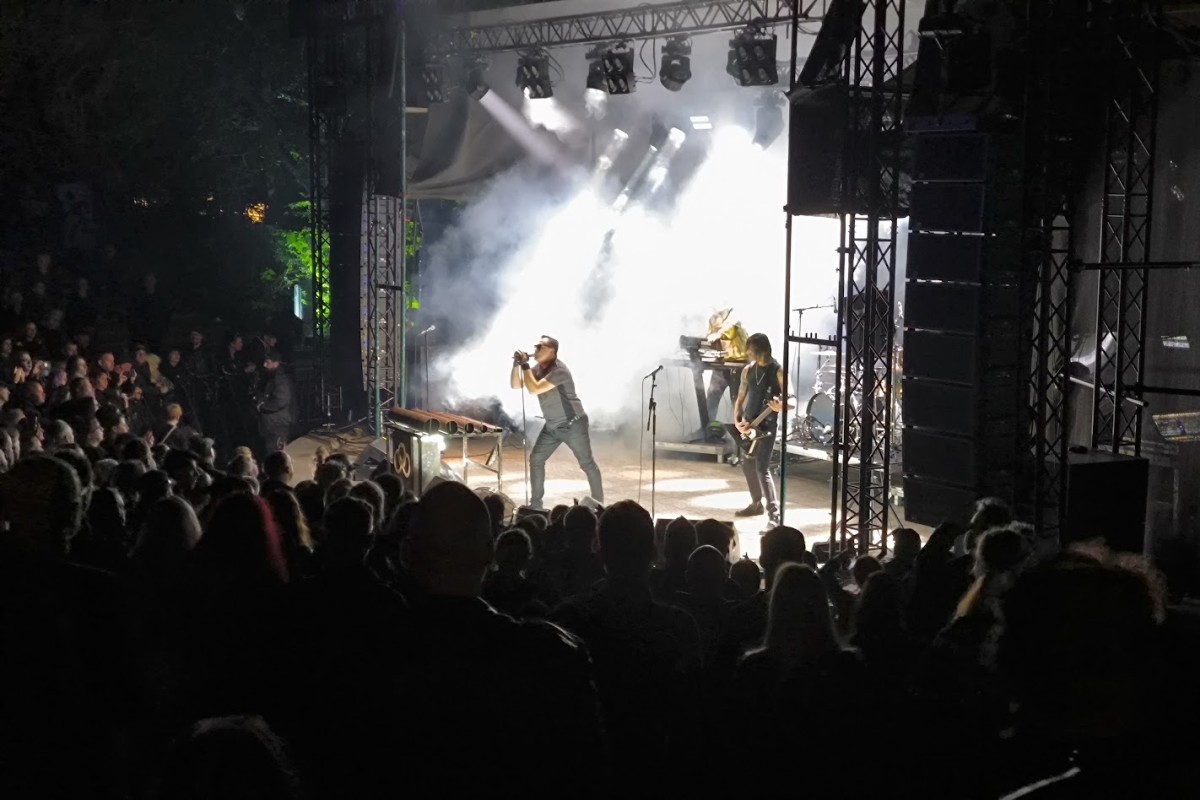
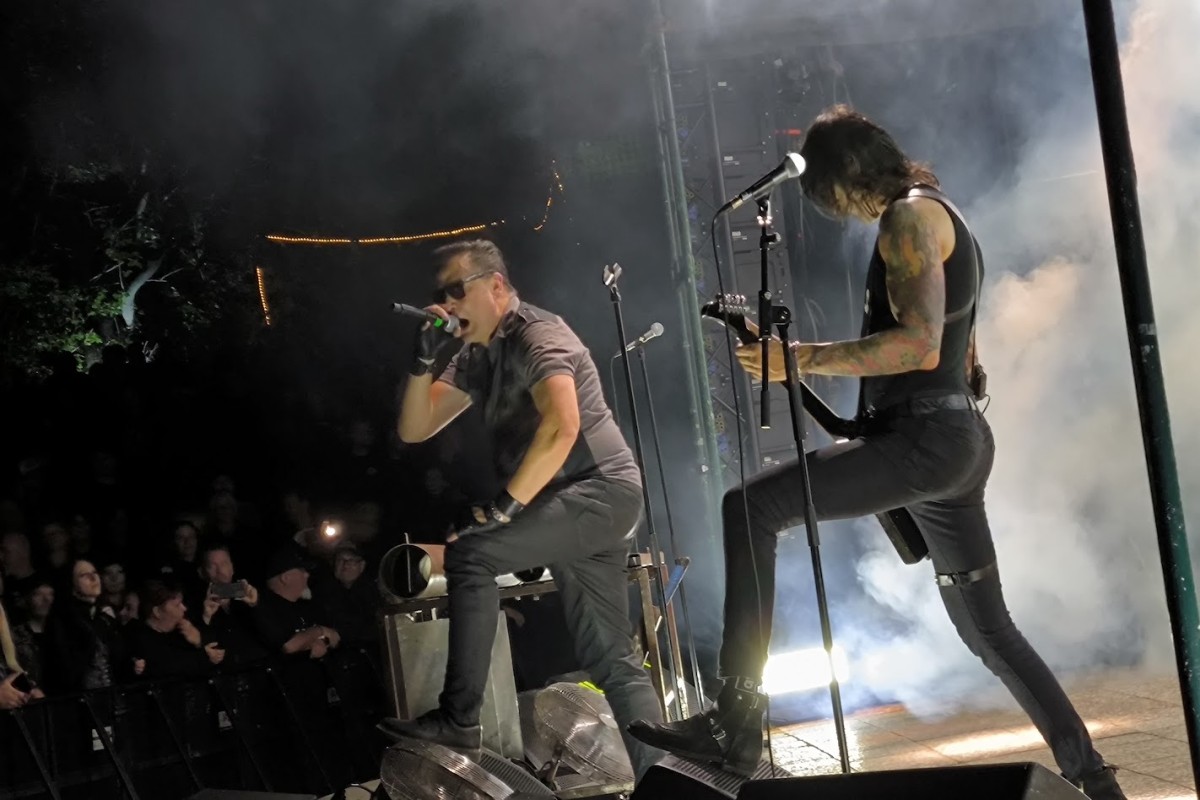
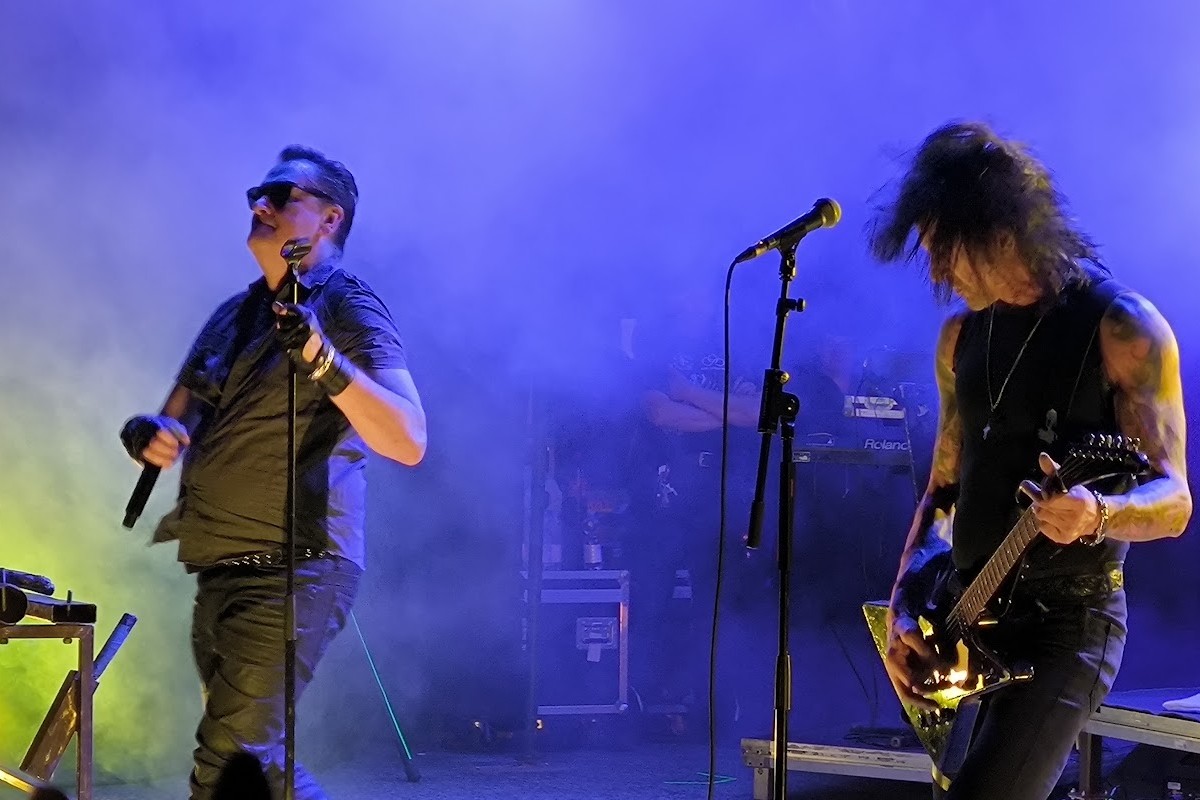
There was always something happening on stage, with frontman Jürgen Engler and guitarist Marcel Zürcher particularly commanding attention through their dynamic presence. Keyboardist Ralf Dörper and drummer Paul Keller, inevitably more restrained behind their instruments, nevertheless played an equally vital role in shaping the band's imposing sonic and visual identity. Over the course of just over an hour, Die Krupps presented a substantial cross-section of their catalogue, drawing heavily from landmark releases such as the monumental II – The Final Option (1993) and The Machinists Of Joy (2013), one of the defining albums of the band's post-reunion era following their return in 2005. The audience was also treated to two well-chosen cover versions, Visage's 'Der Amboss' and S.Y.P.H.'s 'Industrie-Mädchen', both of which slotted seamlessly into the flow of the set. As the show progressed, the atmosphere grew increasingly intense, with crowd favourites such as 'To The Hilt', 'Robo Sapien' and 'Bloodsuckers' driving the energy even higher. At one point, the vocalist even stepped off the stage, climbed onto the security barrier separating the crowd from the stage, and, surrounded by fans, performed almost an entire song from there".
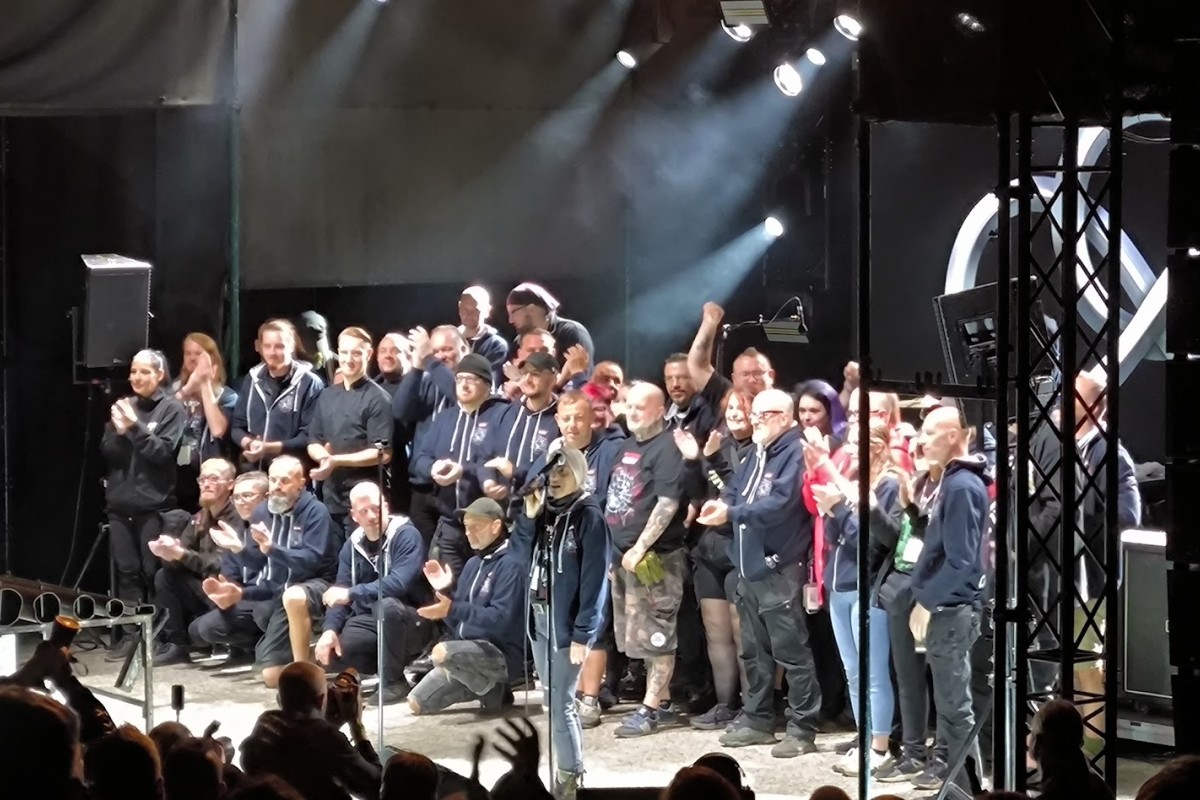
If I'm not mistaken, Die Krupps had one more song on their setlist, "Machineries Of Joy", but they didn't perform it. Instead, one of the festival's main organisers stepped onto the stage and, in German (do bear in mind that my grasp of the language is rather limited), explained that the event had to be brought to a close. A speech followed, perhaps a little longer than I would have liked. From what I managed to gather, it was largely a heartfelt thank-you to everyone who had contributed in any way to making the festival possible. Several key members of the NCN team were then invited onto the stage as well. Perhaps I'm wrong, but I had a feeling that most of those gathered in front of the stage would have preferred another Die Krupps song or two. Still, credit where credit is due: everyone involved in organising festivals and concerts deserves recognition. After all, without their hard work, there would be no events to offer a welcome escape from the routines of everyday life.
----------------
We lingered at the festival grounds a little while longer, just long enough for the bulk of the crowd to drift away, allowing us to avoid the rush before turning in ourselves. We woke shortly before eleven the following morning and, rather intriguingly, almost to the minute, exactly three days after arriving in Deutzen, said our goodbyes at around 13:00. Our original plan had been to spend some time in Leipzig, but we ultimately changed our minds. As we fully intend to attend Wave-Gotik-Treffen one day, we decided instead to trace Friedrich Nietzsche's early years by visiting the places where he was born, raised, and eventually laid to rest.
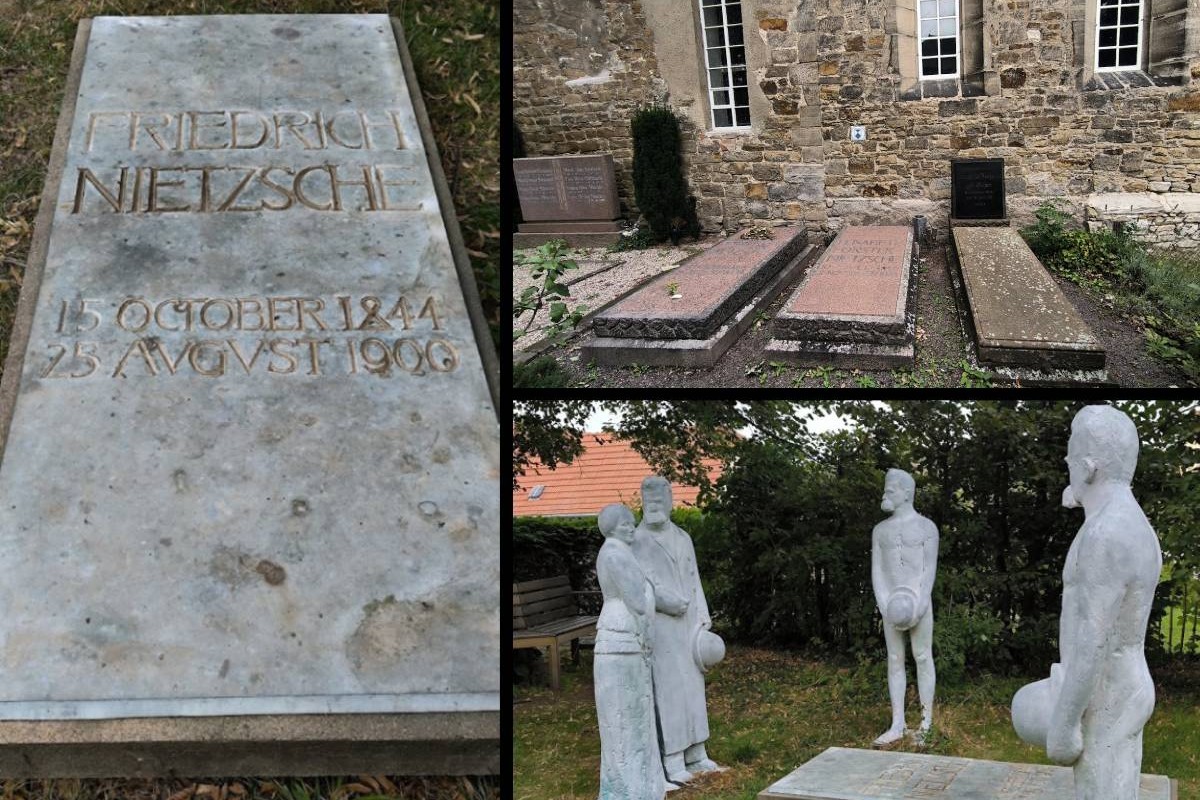
First, we visited his birthplace in Röcken. Unfortunately, we were unable to see inside the house, as visits were not possible that day according to the schedule. Nietzsche is also buried there, and on the opposite side of the church stands an unusual installation comprising several sculptures depicting him. We spent quite some time by his grave before taking a leisurely stroll through the village and eventually settling by the pond behind the local fire station, watching the swans, ducks, and other wildlife go about their day. Afterwards, we followed the local roads to Naumburg, where Nietzsche moved at the age of five following the deaths of his father and younger brother, and where he spent much of his youth as well as part of his adult life. During the latter period, he was cared for by his mother as his mental health deteriorated. The house at Weingarten 18 now serves as a museum, although it too happened to be closed that day. We did, however, run into the museum's curator and enjoyed a pleasant chat with her. We then made our way to a square where a bronze statue of Nietzsche sits holding a menu, while a young woman below appears to be waiting to take his order.
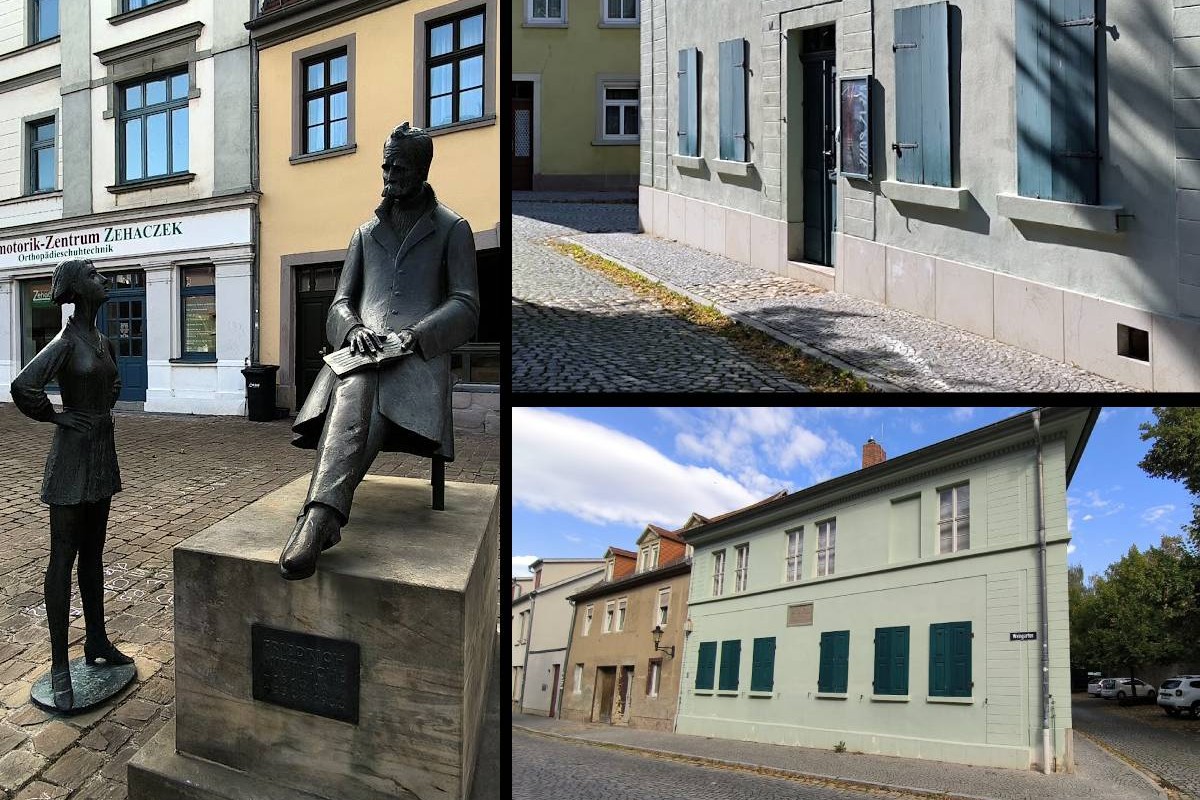
We sat down at a table in the café right next to the statue (I imagine Nietzsche must have popped in here, or somewhere nearby, on more than one occasion) and ordered a large cappuccino. Well, we certainly hadn't expected it to be quite so enormous, as cups of that size are usually reserved for soup. As a result, we lingered a little longer than planned, certainly for at least three-quarters of an hour, but it was lovely sitting there in the pleasant sunshine, in Nietzsche's company. A long journey home followed. That night, we stopped at a car park in Austria beneath a magnificent starry sky, the sort we rarely get to see these days because of all the artificial light. After a few hours of perfectly comfortable sleep in the car, we set off for the Italian town of Grado, which, being situated on an island, is reached via a stunning panoramic road stretching across the sea. We had visited the town a few times before, though never during the swimming season. In the shallow sea, whose seabed was, at least on this occasion, densely overgrown with tall sea grass, swimming was almost impossible. We did, however, manage a little nap on the beach, and towards evening we set off on the final 60 kilometres separating us from home.
Photos by Tomaz
Frantic Fest links: Official website, Facebook